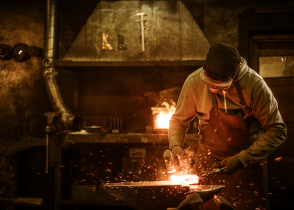
Not every forged component should be manufactured the same way. A forged shaft for mining equipment, an automotive forged assembly, and a seamless rolled ring for oil & gas applications all require different production methods, inspection systems, and manufacturing expertise. For buyers sourcing custom metal forging components from India, understanding those differences can make supplier evaluation more efficient and reduce qualification delays during industrial procurement.
This holds true for industries such as oil & gas, mining, automotive, steel plants, and industrial machinery, where forged components are expected to perform under high load, pressure, and extreme operating conditions.
Open die forging, closed die forging, and ring rolling each support different production requirements depending on component geometry, mechanical performance, and end-use application. For procurement teams sourcing forged industrial components internationally, selecting the right process often becomes the first major step in identifying the right manufacturing partner.
Understanding custom metal forging processes
Each forging method produces different outcomes suited for multiple industrial applications. Matching the right process to the right application is what separates reliable manufacturing performance from avoidable production problems.
| Process | End-Use Applications | Benefits | Buyer Preference |
| Open die forging | Large forged shafts, heavy industrial components, steel plant equipment, mining machinery parts | Open die forging supports components weighing up to 5000 kg and is widely used where structural strength and durability matter more than cosmetic finish. | Buyers sourcing large forged industrial parts often prefer this process for custom manufacturing flexibility and improved grain structure. |
| Closed die forging | Automotive forged components, industrial machinery parts, engineered assemblies, medium-volume industrial production | This process supports tighter tolerances, better repeatability, and reduced post-processing requirements. | Buyers sourcing custom metal forging solutions for automotive and industrial applications often evaluate suppliers based on tooling capability and dimensional consistency within closed die operations. |
| Ring rolling | Bearing rings, oil & gas components, pressure equipment, heavy industrial applications | Compared to machining from solid metal, ring rolling improves material utilisation while maintaining strong grain flow and mechanical performance. | Buyers sourcing forged rings for high-pressure and high-load applications often prefer ring rolling for its strength consistency, material efficiency, and suitability for large-diameter industrial components. |
How buyers select the right custom metal forging process
Forging process selection usually depends on several procurement and engineering considerations, including:
- Production volume
- Dimensional tolerance
- Component geometry
- Mechanical performance
- Material selection
- Finishing requirements
For example, buyers sourcing forged rollers for steel plants may require open die forging for larger dimensions. On the other hand, automotive component sourcing buyers often prefer closed die forging for greater dimensional control.
Supplier evaluation in industrial forging now extends well beyond the forging process itself. The Forging Industry Association notes that buyers frequently review machining capabilities, heat-treatment support, inspection systems, and documentation standards before moving into supplier qualification. Possessing the right forging expertise is no longer sufficient. Many buyers prefer suppliers that have a broader set of integrated services, including:
- Heat treatment
- CNC machining
- Dimensional inspection
- Non-destructive testing
- Export packaging
- Material certification documentation
What to look for in a forging supplier
Supplier comparisons in custom metal forging procurement can be challenging, because manufacturing capabilities vary across suppliers. Buyers typically check these factors.
| Core Capability | Service Offering Feature | Buyer Benefit |
| Inspection and testing capability | Dimensional inspection, ultrasonic testing, dye penetrant testing, hardness testing, spectrometer analysis, material traceability documentation | These inspection systems become particularly important for oil & gas, mining, and heavy machinery applications where component failure can create major production risks. |
| Material expertise | Supplier experience across carbon steel, alloy steel, stainless steel, aluminium, nickel alloys, and titanium | Buyers evaluating forged industrial components often review material expertise to assess application suitability, mechanical performance, and manufacturing capability across demanding industrial environments. |
| Export readiness | Packaging systems, documentation support, shipment coordination, and production communication during supplier qualification | International buyers sourcing custom metal forging services from India frequently evaluate export readiness to support smoother procurement coordination, shipment management, and supplier communication across overseas sourcing programs. |
How rivexa supports custom metal forging sourcing from India
rivexa simplifies custom metal forging by connecting global buyers with verified Indian forging specialists who offer open-die, closed-die, and ring-rolling processes.
It is an all-in-one sourcing marketplace that enables easier supplier discovery, RFQ coordination, inspection facilitation, export documentation support, and sourcing assistance for industrial forging requirements.
As procurement teams continue evaluating forging suppliers across global manufacturing markets, process selection and supplier qualification are becoming central to industrial sourcing decisions.
If sourcing custom metal forging solutions from India is part of your next business plan, then our sourcing marketplace is where that plan becomes a sourcing reality.
Your next custom metal forging supplier is already verified on rivexa. Speak to our sourcing specialists today.

Leave a Reply