
The European Union’s Carbon Border Adjustment Mechanism (CBAM) has entered its definitive phase from January 1, 2026, making it one of the most important trade developments affecting exporters supplying goods to Europe. Introduced as part of the EU’s climate strategy, CBAM places carbon-linked costs on certain imported products based on their embedded emissions.
For Indian exporters, this means procurement conversations with EU buyers may increasingly involve requests for production visibility, support for reporting, and emissions-related documentation.
Why Indian Exporters Must Act Immediately
Under the current framework, importers in the EU now face financial liabilities tied to their imports. For them, emissions data reports submitted without accredited independent verification are rejected. This has created growing concerns across export-heavy industries in India, particularly steel and aluminum.
- CBAM Transitions from a Reporting Tool to a Financial Monitor
The shift from simply emissions data tracking to a hard financial mechanism creates immediate commercial pressures. For Indian exporters, understanding this transition is key to navigating new procurement cycles:
- Mandatory independent verification:
All submitted emissions data must now be audited by an EU-accredited independent verifier. Data lacking this formal verification will be rejected by EU customs portals, triggering punitive, inflated “default values” that drive up your product’s final price in European markets.
- The financial offset rule:
All importers in the EU must purchase CBAM certificates matching the embedded emissions of their imports. However, any verified carbon price or environmental levy already paid in India can be officially deducted from this final border fee.
- The lagged payment cycle: compliance gaps block sales
A common misconception among suppliers is that CBAM works like a standard customs tariff paid directly at the border. It does not. CBAM operates on a lagged payment cycle, meaning EU buyers accumulate your goods all year and settle the total carbon tax bill months later, in the following year. In other words, they track your data all year, log into the official registry, and must surrender the matching certificates by May 31st of the following year (Gecic Law; CBAM Compliance & Risks).
For example, for all the shipments you send to Europe throughout 2026, the financial timeline looks like this:
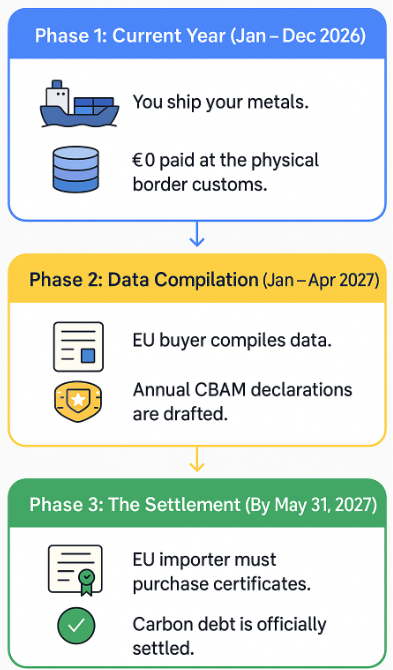
Current year (data accumulation): Throughout the calendar year, your EU buyer imports your steel and aluminum components. They collect your data, but they pay €0 in carbon fees at the physical port of entry.
Following year (financial settlement): The deadline for the importer to officially purchase and surrender CBAM certificates to clear that accumulated carbon debt is May 31 of the following year.
Certification Challenges Indian Exporters may Face
- Carbon market mismatch
India launched its own Carbon Credit Trading Scheme (CCTS) (0.5.2, 0.5.16) under the Bureau of Energy Efficiency. However, the EU does not recognise these credits.
Consequence: Until India and the EU sign a Mutual Recognition Agreement (MRA), Indian metal exporters face double taxation or cannot use domestic compliance to lower their EU border fees (CEEW; ICWA).
- Punitive default values penalties
Indian industrial manufacturing relies heavily on coal-fired power plants and carbon-intensive production routes, such as coal-based Direct Reduced Iron (DRI) for steel.
Consequence: Because India’s average grid emissions are highly carbon-intensive, failing an EU audit triggers worst-case ‘default values.’ This completely wipes out the price competitiveness of Indian steel and aluminum in Europe.
- Upstream MSME bottleneck
Major Indian steel and aluminum giants rely on thousands of domestic Micro, Small, and Medium Enterprises (MSMEs) for raw materials, scrap sorting, and engineering components.
Consequence: Bigger conglomerates have the capital to track carbon; Indian MSMEs lack basic data-logging infrastructure. Because CBAM requires a strict ‘cradle-to-gate’ calculation, large Indian exporters cannot complete with their EU paperwork if their smaller sub-contractors can’t supply the math (CCEW).
- EU-accredited verifier shortage
India has local environment auditors, but very few have been officially vetted and accredited under EU standards to issue CBAM compliance certificates.
Consequence: Shortage of qualified locally available accredited agencies pushes exporters to compete for a limited pool of expensive global auditing firms like SGS, DNV, or TÜV, driving up compliance costs.
Practical steps Indian Exporters can Take Now
The CBAM regulation hits steel and aluminium the hardest because they face the strictest reporting requirements, covering both raw materials and downstream products such as bolts, screws, and structures.
Aluminum: Covers unwrought aluminum, aluminum powders, plates, steel, strip, foil, tubes, pipes, and structures (aluminum window frames, scaffolding, etc.)
Iron & Steel: Covers iron ore, scrap metal, unalloyed steel, sheets, tubes, and pipes, as well as downstream components like bolts, nuts, screws, and steel washers.
When facing strict product definitions, compliance cannot wait. Take these five practical steps now to keep your exports competitive.
- Secure EU-accredited verifiers early
- Standardise emissions tracking via ISO frameworks
- Deploy carbon-accounting software to upstream MSMEs
- Optimise production to make use of green energy
- Document local carbon taxes for deductions
Final thoughts
CBAM raises the bar for supplier documentation. Being prepared is one thing, making those credentials visible to the right buyers is another.
For Indian exporters ready to take that next step, the right platform is already here. rivexa connects Indian suppliers with global buyers, helping them showcase certifications, capabilities and strengths to potential buyers.
Register now to start building the export relationships your business deserves, in full compliance.

Leave a Reply