Tariffs are rarely the whole story when it comes to trade. What matters most to exporters are the changes that buyers make to their sourcing plans when costs move. Freight plans, pricing calculations, and supplier negotiations can be influenced by smaller tariff modifications.
For this reason, industry groups generally prefer to watch how conditions develop before acting. In global trade, sourcing adjustments typically unfold gradually rather than overnight.
For Indian exporters, the discussion is not limited to the tariff rate itself. The deeper question is how global buyers react when trade conditions begin to change. There are several factors that play into finalising buying decisions.
Recent reporting in international media suggests that the current tariff environment may settle at around a 10% duty rate for certain product categories, though exporters remain cautious as conditions stabilise.
Trade between the United States and India in 2023 was valued at over $190 billion. Industry analysts note that modest tariff changes affect final price points, sourcing and freight planning. For some exporters, minor duty adjustments can even affect the competitiveness of product categories.
The result is a familiar pattern in global trade. When tariff discussions reappear, exporters begin examining where risks may surface and where opportunities may emerge.
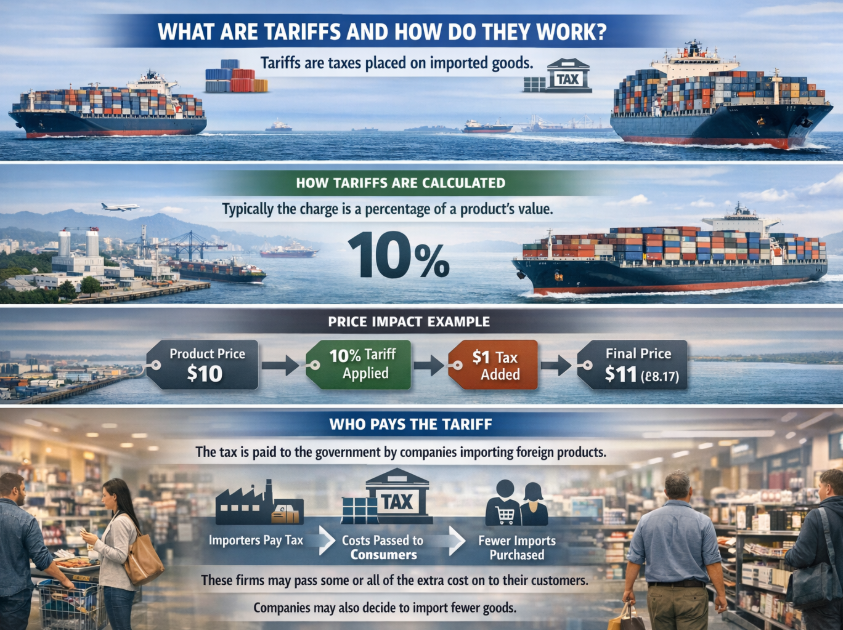
Why tariff developments attract attention from exporters
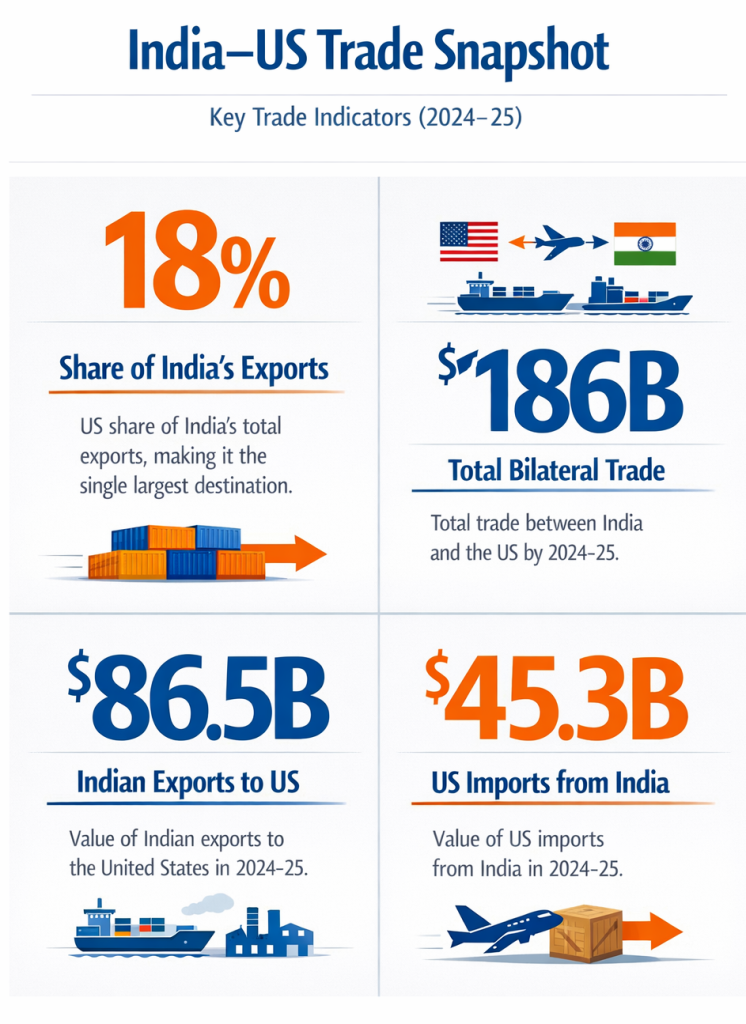
The United States remains India’s most important export market. According to government trade data, the US accounted for 18% of India’s total exports in recent years, making it the single largest destination for Indian goods spanning industries such textiles, engineering goods, jewelery, and agricultural products. Given this level of exposure, any discussion involving US tariffs naturally attracts attention across India’s export sector.
Between 2021 and 2025, the United States consistently ranked as India’s largest trading partner in goods, spanning textiles, pharmaceuticals, engineering goods, jewellery, and agricultural products. It accounted for about 18% of India’s exports, 6.22% of imports, and 10.73% of bilateral trade.
Trade policy changes rarely translate immediately into changes in sourcing behaviour. Global buyers typically take time to assess how tariffs affect their cost structures before making adjustments to supply chains.
Industry associations have therefore advised exporters to monitor developments while continuing existing operations. In international trade, the initial response to tariff changes is often more about observation rather than immediate action.
Sector exposure: where tariff effects may appear first
Although tariffs can influence many industries, some sectors are more sensitive to trade policy changes than others. Industries that rely heavily on export markets and operate with relatively tight pricing margins often react first. For India, these sectors include:
- Textiles and apparel
- Footwear and leather goods
- Certain engineering products
These industries cater to markets where buyers frequently compare prices across popular sourcing destinations like Indonesia, Vietnam, China and Bangladesh. Minor cost differences do have real weight on sourcing plans revolving large-volume orders.
The United States is still one of the most significant markets for Indian apparel and textile exports, with the AEPC estimating that one-third of India’s apparel exports go to the US. Footwear and leather goods represent another export category closely linked to international demand. India ranks among the world’s major producers of leather products and footwear, with a large portion of output directed toward overseas markets.
What buyers tend to do when tariffs change
From a sourcing standpoint, tariff developments seldom lead to sudden changes in supplier relationships. Buyers tend to revise sourcing strategies incrementally. When tariffs increase or enter an unpredictable phase, several responses are common.
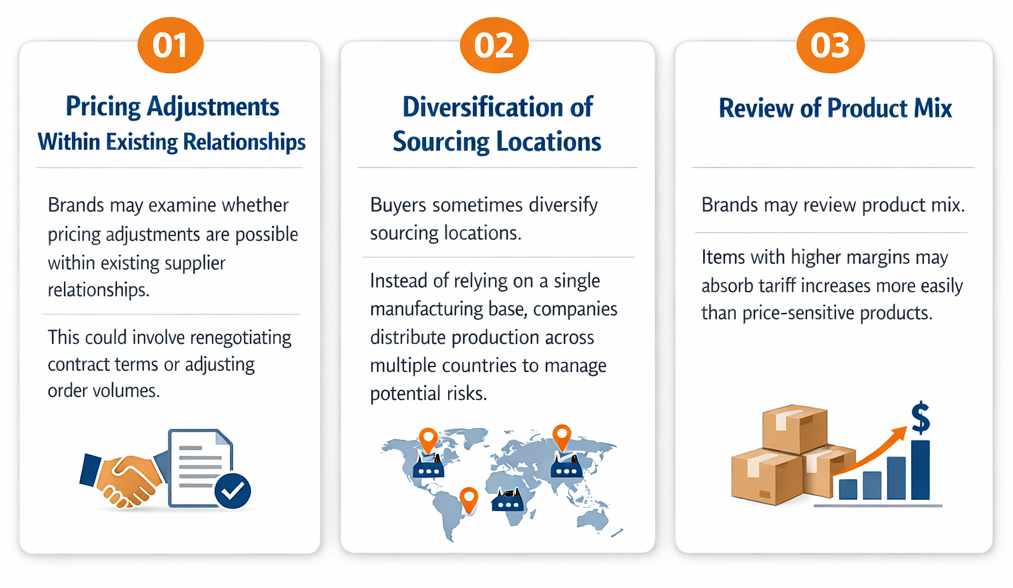
Beyond that, sourcing decisions involve more than tariff calculations. Supplier reliability, manufacturing expertise, compliance standards, and production timelines are routinely given the same level of consideration. For that reason, changes in tariff tend to influence sourcing strategies incrementally rather than all at once.
India’s current position in global sourcing
Tariffs by themselves are not expected to redraw global sourcing maps any time soon. Buyers weigh duty structures along with other factors like production capacity, supplier reliability, and logistics networks. India’s export base is closely connected to some of the world’s largest consumer markets, with the United States being a particularly significant one.
Those structural trade relationships provide a degree of insulation. Tariffs will shape how pricing gets discussed, but they are not likely to push buyers away from well-established sourcing networks overnight. Even with the attention its receiving, the current tariff environment hasn’t changed India’s competitive position in several export categories.
“The 10% U.S. tariff, though a concern, is significantly lower than the higher duties Indian exporters have faced earlier, placing them in a relatively better position. Since it is applied uniformly across countries, our competitive standing remains largely unaffected. A supportive exchange rate further cushions the impact, enabling exporters to remain resilient and competitive in the US market.”
FIEO (Federation of Indian Export Organisations) Director General Ajay Sahai (Times of India).
However, tariff exposure remains uneven across industries. Other sectors such as aluminum, steel and automobiles and auto parts continue to face 50% product-specific levy under Section 232, highlighting how tariff policy can affect export sectors differently (Times of India).
Tariffs can influence pricing dynamics within the global supply chain system, but they rarely determine the entire outcome. For many exporters, the larger question is not whether tariffs exist but how long they remain in place.
Short-term tariff cycles are often absorbed within global sourcing networks, while sustained policy changes tend to reshape sourcing decisions more gradually. In that context, India’s manufacturing base and long-standing trade relationships continue to play a stabilising role within global trade.
India’s manufacturing base and established trade relationships have remained a steadying presence within global sourcing networks through this process. For several buyers, India’s mix of strong production capacity, certified supplier networks, and export experience outweighs short-term fluctuations. The more pointed question is how sourcing patterns will respond as trade policy continues to change.

Leave a Reply