
On January 27, 2026, the global trade landscape entered a new operating phase with the finalisation of the India-European Union Free Trade Agreement (FTA). Frequently described as the largest trade deal ever concluded by either side, this landmark accord joins two of the world’s largest democratic markets, encompassing 2 billion people and nearly 25% of global GDP, into a unified free trade zone.
Cost reduction is the surface conversation. For global procurement leaders, the deeper one is about risk and how well it is understood. By diversifying away from volatile trade corridors and anchoring operations in India, the EU has institutionalised India as its most “privileged” partner, offering a strategic hedge in an increasingly multipolar order.
The immediate financial impact: “day one” wins
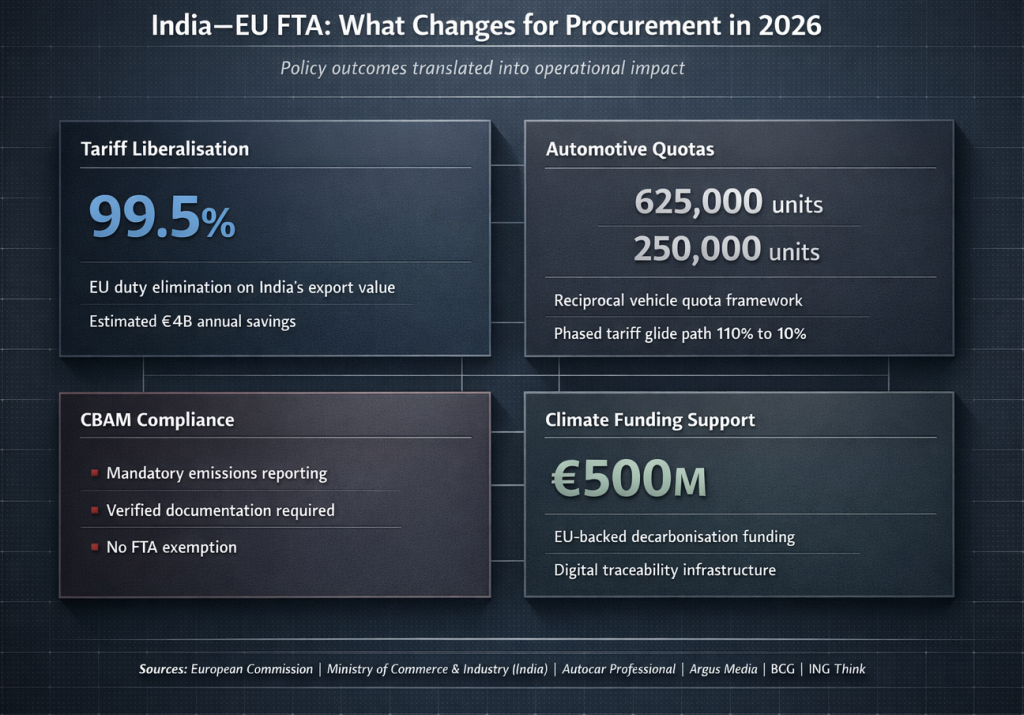
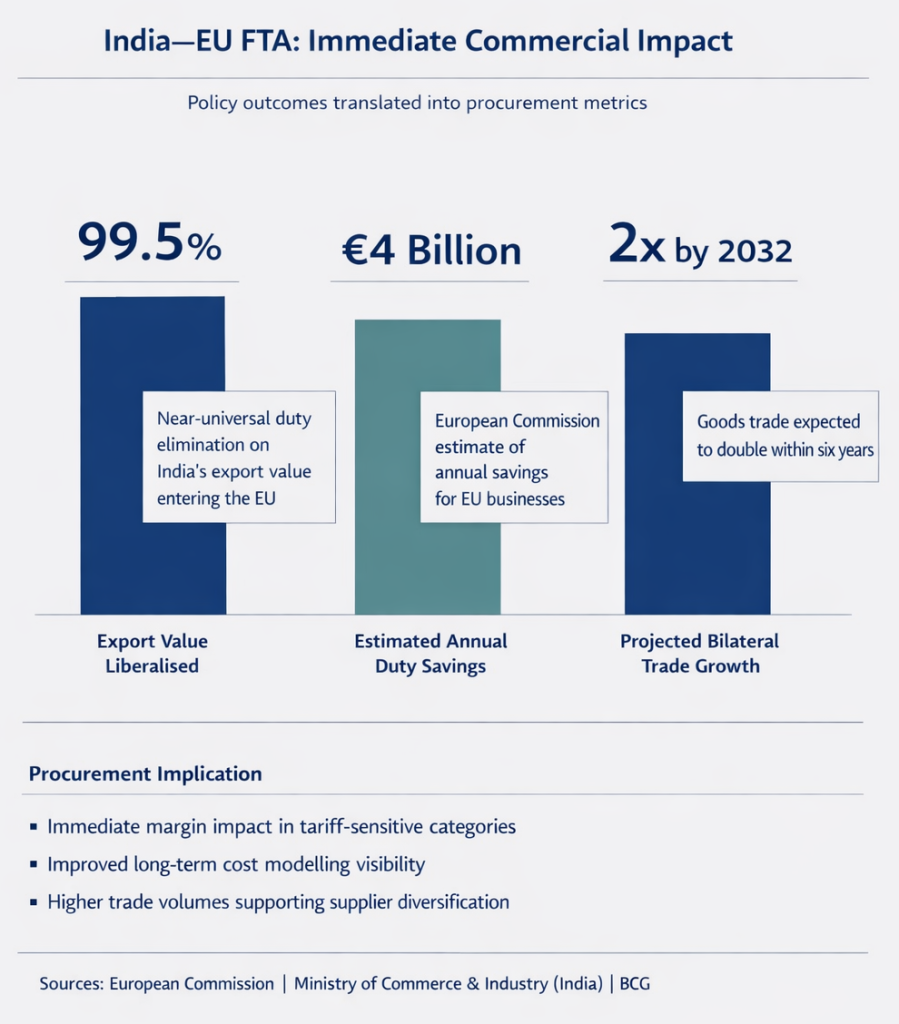
The financial implications for sourcing from India are commercially significant, particularly for industries operating on thin margins. The agreement provides near-universal preferential access, with the EU eliminating duties on 99.5% of India’s export value. The European Commission estimates that these reductions will save businesses approximately €4 billion per year in duties on products, while bilateral goods trade is expected to double by 2032.
Labour-intensive sectors
The immediate zero-tariff access has been granted for 90.7% of India’s export value in sectors such as textiles, apparel, leather, footwear, gems and jewellery. These categories previously faced EU tariffs ranging from 9% to 12%. The elimination of these tariffs places Indian manufacturers on equal footing with regional competitors like Vietnam and Bangladesh.
The component advantage
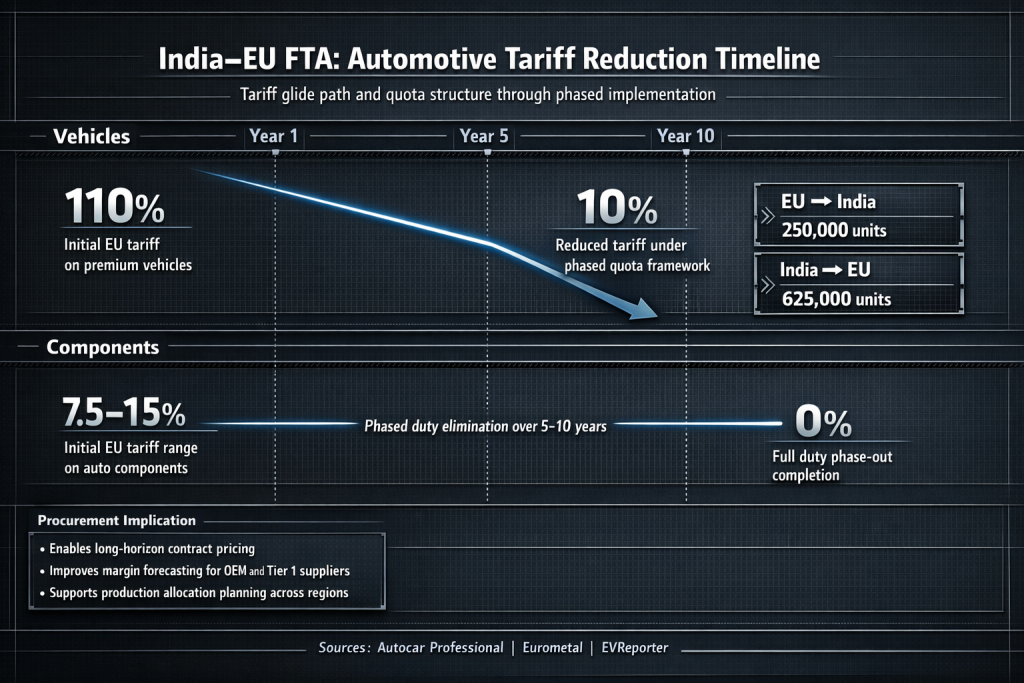
For the automotive and industrial sectors, the deal provides a predictable “glide path” for pricing. While tariffs on unfinished premium vehicles will gradually drop from 110% to 10% within a 250,000-unit quota, duties on automotive components varying from 7.5% to 15% will be gradually stopped over the next five to ten years. This allows procurement managers to model long-term contracts with high technical precision and pricing stability.
The ‘X’ factor: regulatory certainty and IP protection
The “real value” of the FTA lies in its regulatory depth, which addresses the friction points that traditionally complicate cross-border trade. The agreement moves beyond standard WTO protocols to provide a secure environment for high-value engineering and technology transfer.
IPR shield
The agreement incorporates “TRIPS+” standards, providing a high level of protection and enforcement for trade secrets, industrial designs, and plant varieties. This gives global buyers the legal protection when transferring proprietary technology to Indian manufacturing facilities, knowing that their intellectual property is safeguarded by international-grade legal remedies.
Standardisation and efficiency
To reduce paperwork “friction”, the deal aligns Product Specific Rules (PSRs) with existing global supply chains. The documentation system adopts modern self-certification standards, allowing exporters to upload statements of origin directly to a digital verification portal, which streamlines customs clearance and minimises border delays.
Navigating the ‘green wall’: CBAM and sustainability
Sustainability has transitioned from a compliance requirement to a core commercial differentiator. The India-EU FTA establishes a formal cooperation framework for dialogue on climate action while acknowledging the reality of the Carbon Border Adjustment Mechanism (CBAM).
The reality check
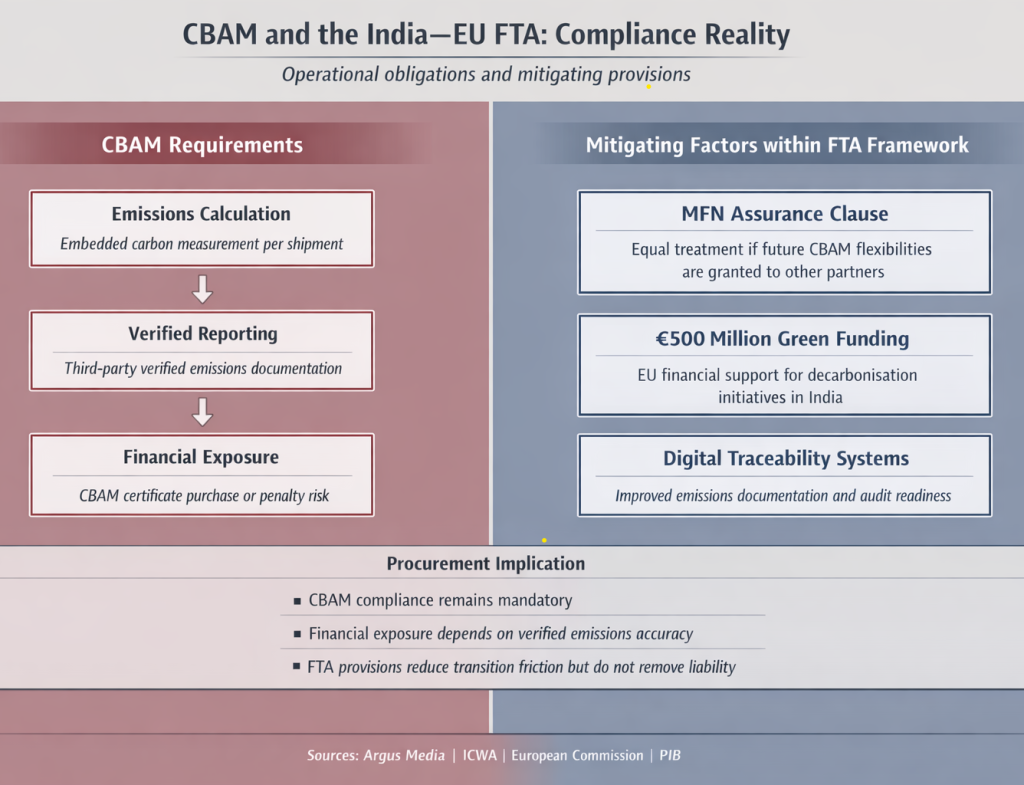
The FTA does not provide an exemption from CBAM, which entered its definitive phase on January 1st, 2026. Indian exporters of carbon-intensive goods like steel and aluminium must continue to calculate and provide verified emissions data or face financial penalties that can potentially cost billions annually.
The silver lining
India has secured a “Most Favoured Nation” (MFN) assurance. If the EU grants future CBAM flexibilities or exemptions to any other trade partner, India is legally entitled to the same treatment.
Technical funding
The EU has pledged €500 million in green funding over the next two years to help Indian manufacturers decarbonise and implement the digital traceability systems required for EU audits. This makes “Green Sourcing” from India a more subsidised and technologically supported venture than in any other emerging market.
Competitive analysis: why India vs. the world?
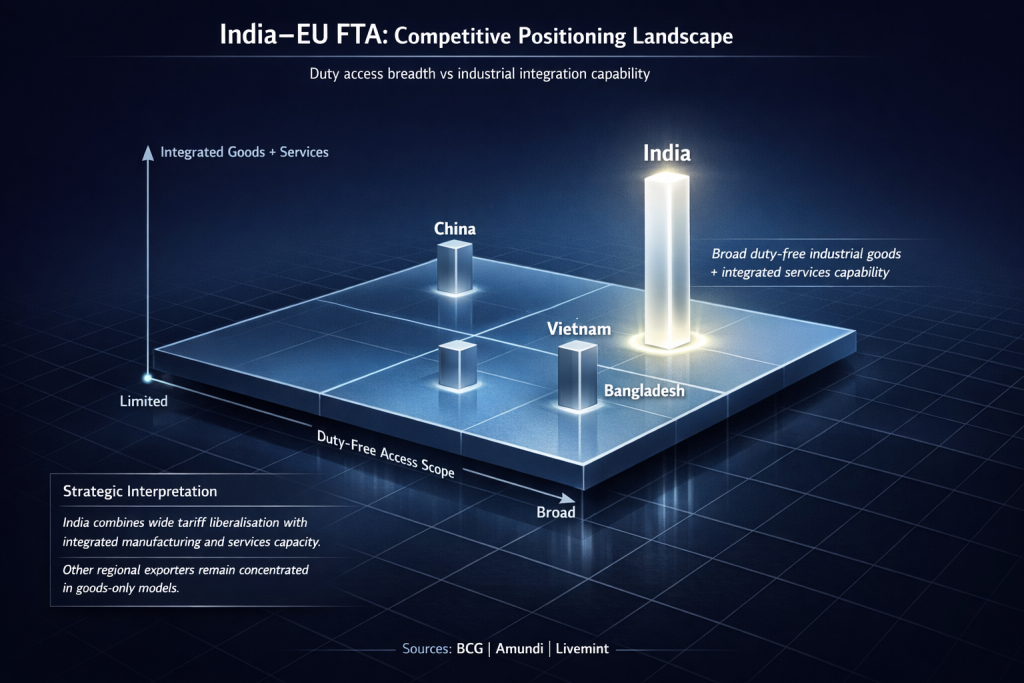
The India-EU FTA provides a distinct edge over traditional regional competitors. While countries like Vietnam and Bangladesh enjoy duty-free access for low-value goods, India is the only partner offering a “full-stack” advantage combining duty-free industrial goods with high-tech services and design capabilities in a single framework.
The quota advantage
India has secured a massive duty-free export quota for 625,000 vehicles in the EU market, a volume nearly triple the 250,000-unit quota granted to the EU in return. This reciprocal access allows Indian-based manufacturing plants to expand export volume significantly.
Cost and legal fundamentals
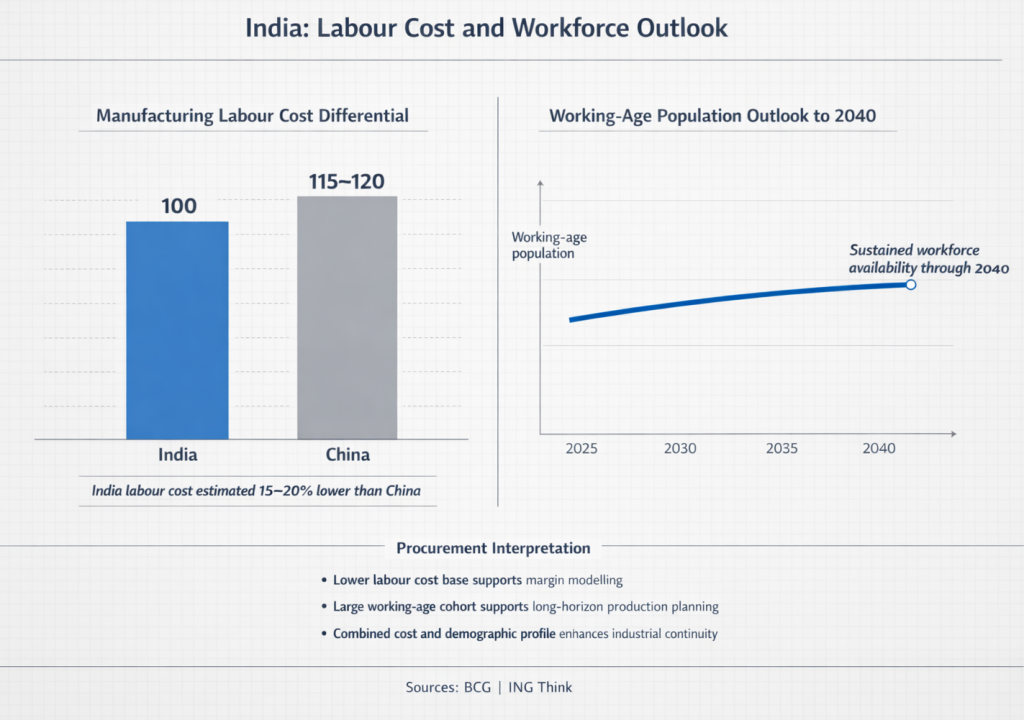
India’s labour cost remains 15% to 20% below Chinese levels, and it’s working-age demographic supports long-term labour availability for industrial investment. Unlike its neighbours, India provides a common-law legal system and a mature IT services sector that facilitates the digital integration of supply chains.
The strategy for 2026 and beyond
The finalisation of the India-EU FTA is a landmark movement that marks the beginning of a new strategic direction. Sourcing from India now sits at the core of long-term supply chain strategy. Buyers should not wait for the multi-year ratification process to conclude before acting; the 14th round of talks in late 2025 has already set their technical stage for immediate implementation.
Digital B2B marketplaces like rivexa are critical in this new era, enabling procurement leaders to identify and engage with verified Indian manufacturers of apparel and industrial goods and components.
Explore verified Indian manufacturers and build a sourcing strategy aligned with the India–EU FTA’s new tariff and compliance landscape. Talk to our sourcing team.

Leave a Reply