
Global buyers continue sourcing home textiles from India, but the way suppliers win orders from those buyers has changed over the last few months.
India has exported home textiles valued at over $6.08 billion between January and September 2025. While the sector continues to demonstrate resilience, export volumes remain below previous peak levels (Fibre2Fashion, 2025). A key concern is market concentration, with more than 50% of exports directed towards the United States. This leaves suppliers vulnerable to demand fluctuations and macroeconomic shifts within a single geography (Fibre2Fashion, 2025).
At the same time, rising input costs are adding further pressure across the value chain. Synthetic fibre prices have increased by approximately 20% to 30%, while packaging costs have risen by as much as 40% (The Times of India, 2026).
The implication is clear: global buyers have not reduced their interest in sourcing from India; they’ve become more selective in choosing their supplier partners. Increasingly, buyers are prioritising suppliers who can demonstrate consistency, compliance, transparency, speed and supply chain resilience, alongside competitive pricing.
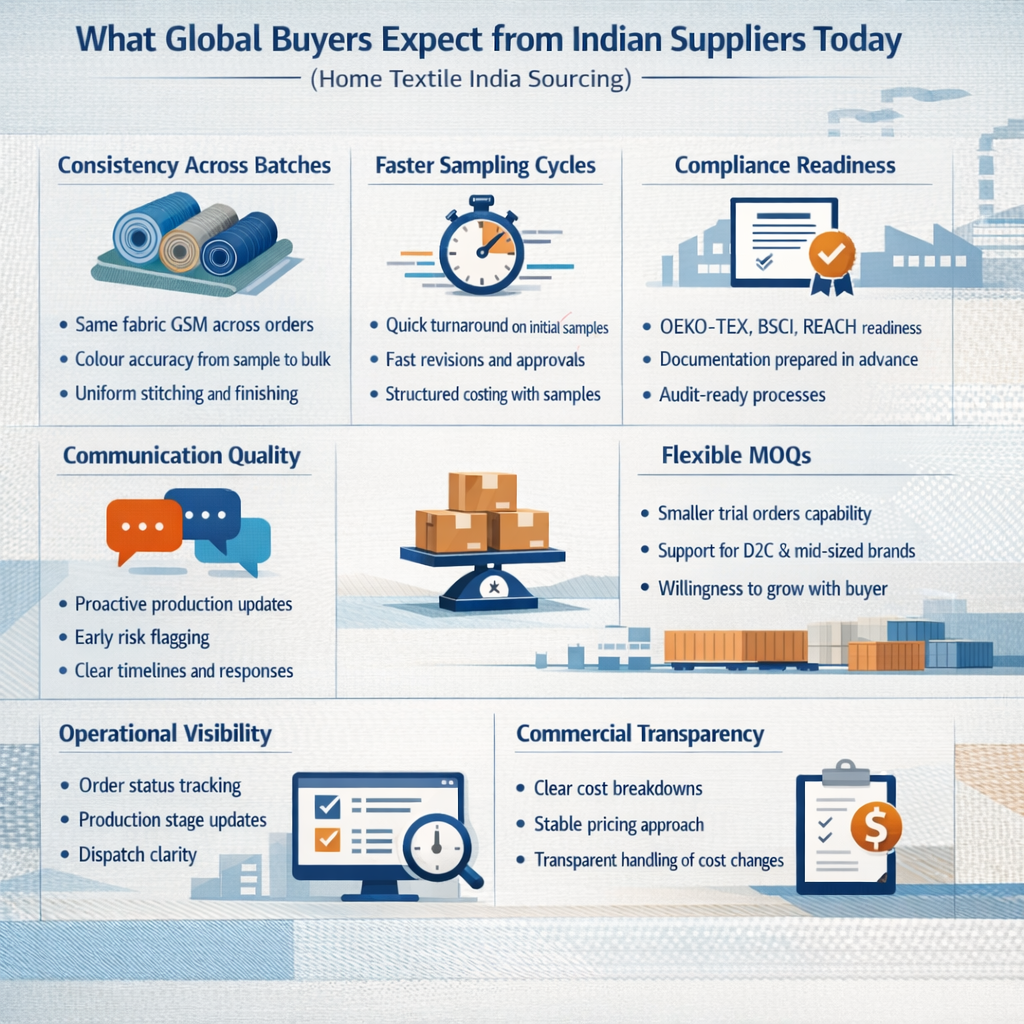
What Global Buyers Expect from Indian Suppliers
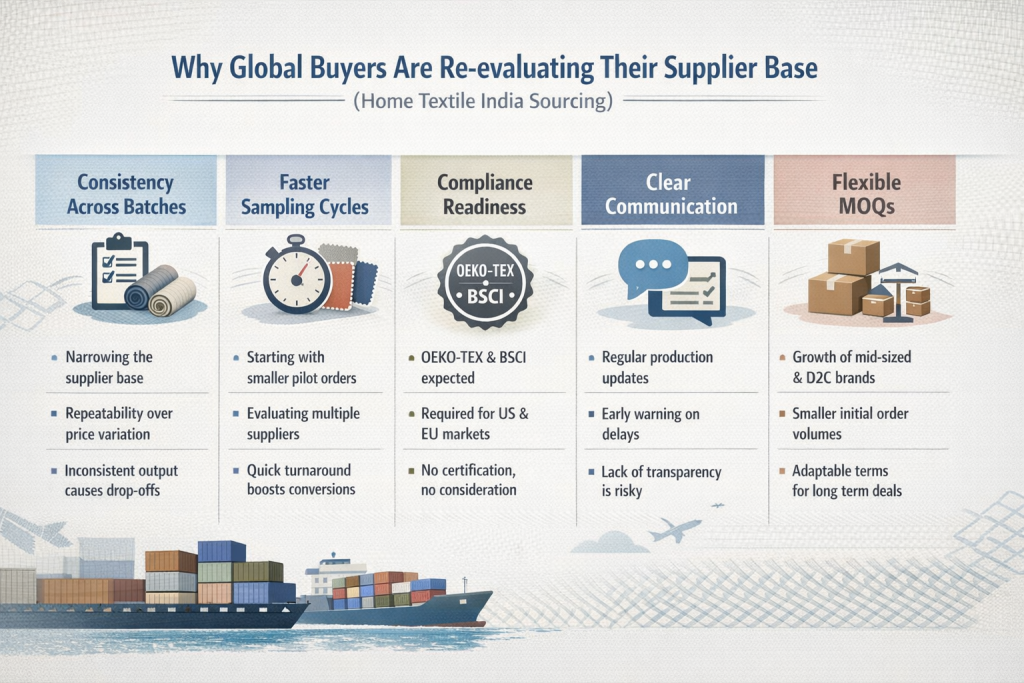
When it comes to home textile sourcing from India, expectations are increasingly driven by how global buyers evaluate and handle supplier risk. With exports still below peak levels and demand uneven across regions, buyers are reducing risk by working with fewer, more dependable suppliers (Fibre2Fashion, 2025).
Exporting Hurdles Faced by Indian Home Textile Suppliers
As buyers reduce their supplier base and test new vendors cautiously, even small execution gaps can lead to lost opportunities. In sourcing home textiles from India, buyers are actively comparing suppliers on execution reliability, not just product capability.
- Delays in sampling and early-stage response
In sourcing home textiles from India, early responsiveness often becomes the deciding factor between winning or losing an order. Buyers evaluate multiple suppliers simultaneously, where even a delay of a few days can result in the order being moved to another supplier. The first interaction often determines whether a supplier stays in consideration.
- Slow response to RFQs
- Delayed sample dispatch
- Lack of clarity in sample costing
- Inconsistent Product Finishing Across Batches
First-order success means little if quality varies across batches. Batch-to-batch inconsistency is what actually ends supplier relationships, through smaller reorders or a quiet switch to someone else.
- Shade variation between lab dips and bulk production
- Fabric shrinkage inconsistencies
- Stitching quality variation across units
- Weak Documentation and Export Readiness
Buyers do not see documentation errors as minor administrative slip-ups. When documentation errors do occur, this is the picture from the buyer’s side: late shipments, additional costs they haven’t planned for, and a supplier who proved unreliable when the margin for error was already small.
- Missing/falsified compliance or certification documentation
- Mismatches in invoice numbers, packing list details, and HSN codes
- Delays in customs clearance due to incorrect paperwork
- Lack of Production and Order Visibility
Order visibility is a must. When freight conditions are volatile, order tracking becomes tougher. Buyers need frequent updates on where their orders are at all times. Without this information, buyers view the supplier as unreliable.
- No structured production updates
- Unclear timelines for completion and dispatch
- Limited visibility into delays or bottlenecks
- Rigid Commercial Approach in a Changing Market
Buyers are aware that the market has since moved on. They are testing cautiously, committing to smaller volumes, and watching how suppliers respond to market conditions.
- High MOQs without flexibility
- Resistance to smaller trial orders
- Limited willingness to iterate on product specs
- Limited Differentiation in a Crowded Supplier Base
Buyers know that they have plenty of options when it comes to finding capable manufacturers in India:
- Many suppliers offer similar products
- Decision-making shifts to reliability and ease of working
What Indian Suppliers Need to Do Differently To Win Global Demand
Winning export orders today depends on improving execution discipline through a few practical actions:
- Treat sampling as a conversion step
Sampling speed and presentation influence buyer decisions. Structured costing and clear communication improve conversion.
- Build Export Readiness
Accurate documentation and certifications that are correct just before the shipment phase move orders faster. Government duty reductions on textile inputs add another lever, offering suppliers roughly around 10% in cost relief (The Times of India, 2025).
- Improve Communication Quality
Good communication is another ‘X’ factor that global buyers look for in the suppliers that they work with. Clear, frequent communications reduce overseas sourcing friction to a great extent.
Digital Sourcing: A New Advantage for Indian Suppliers
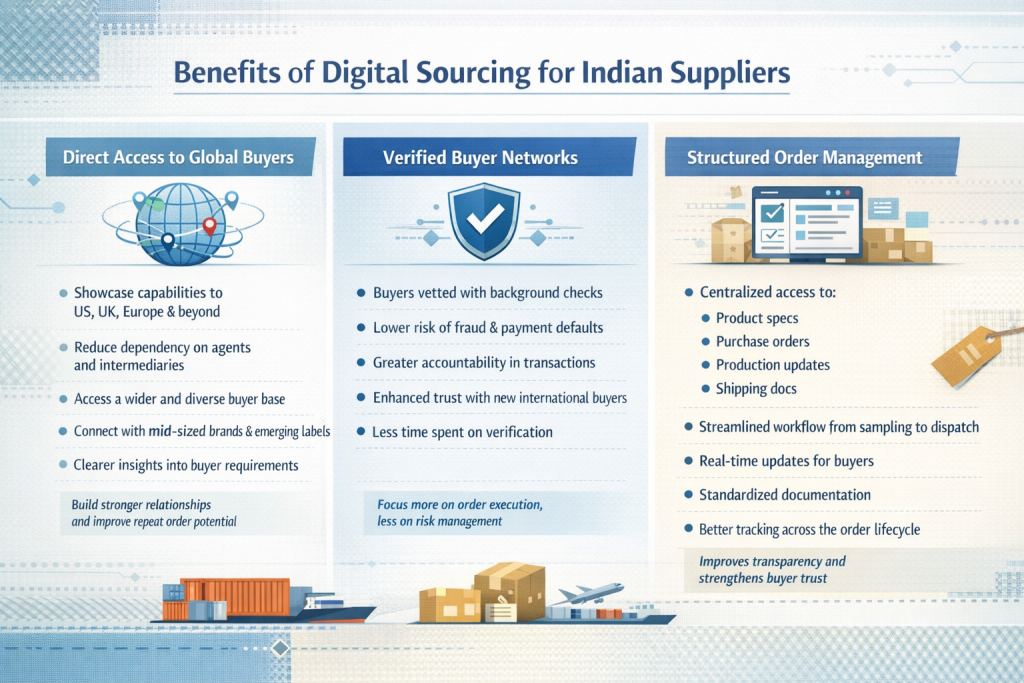
Digital sourcing is a new way to do business. It works in two ways: global buyers discover and evaluate suppliers, and have a more secure method of managing orders.
Payment Security and Working Capital Support
Mechanisms such as invoice discounting are gaining importance in export transactions. This is especially relevant when global buyers extend payment cycles during uncertain demand periods:
- Working capital pressure reduces
- Suppliers can receive early payment against invoices
- Risk of delayed international payments is lowered
Sourcing home textiles from India is increasingly moving toward digital platforms that offer visibility along with stronger payment protection. Digital sourcing is not just about supplier discovery. It brings process clarity and payment security, both critical for exporters.
If you are an Indian supplier looking to grow your export business and connect with global buyers sourcing home textiles from India, rivexa helps you access demand, manage orders, and secure payments with greater clarity.
Take control of your export growth. Reach global buyers easily, manage orders in a better way, and secure payments digitally. Contact us now to get started.

Leave a Reply