A trade negotiation in progress can be just as consequential as one that is done. The India-US trade conversation is at that point now. The framework exists, negotiations continue, and some sector-level changes have already begun to appear.
Announced in February 2026, this Interim Trade Agreement between the US and India secures India’s standing as a manufacturing partner connecting American and European supply chains as well.
For global sourcing teams, waiting for a full agreement is less useful than reading what current developments already indicate about the trajectory of this industrial relationship. Official figures point in one direction:
In 2024, the India-US goods and services trade was estimated at $212.3 billion, a sharp 8.3% increase on the previous year (US Trade Representative data).
Goods trade specifically reached $149.4 billion in 2025. Of that, US exports to India accounted for around $45.6 billion, while imports from India were valued at $103.8 billion (USTR).
Where the India-US agreement currently stands
Despite expanding trade relationships, the India-US agreement is not yet a full free trade agreement. Instead, the two countries have developed an ‘interim trade framework’ aimed at improving market access and addressing tariff barriers while broader negotiations continue (USTR statements reported in Economic Times).
18% baseline pivot for competitiveness
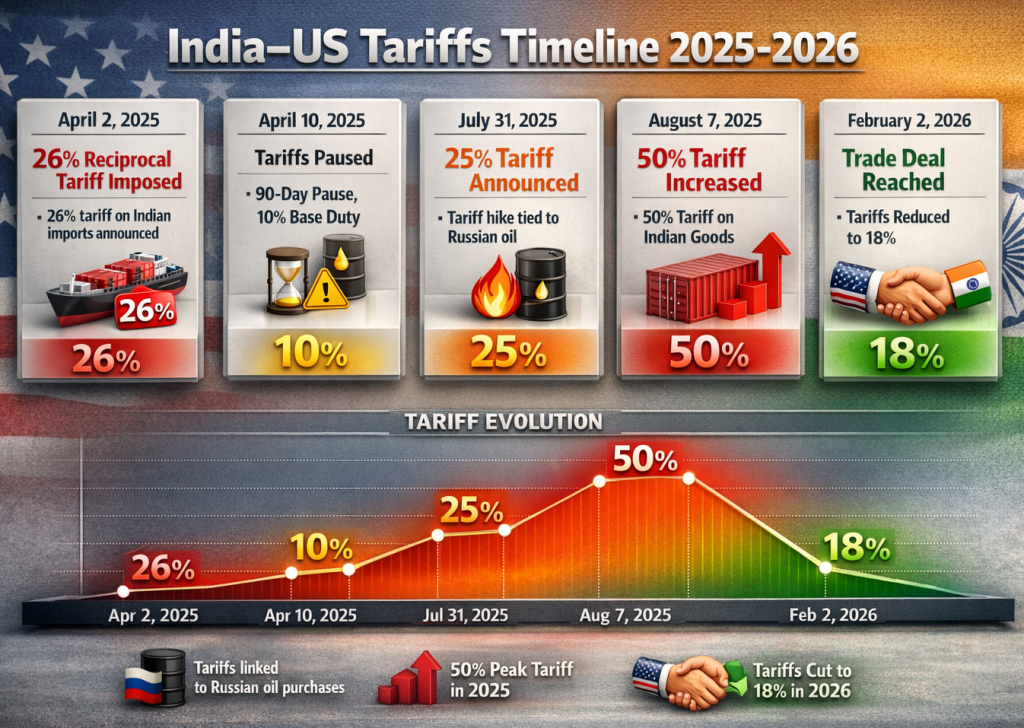
The most immediate impact of the India-US ITA is the correction of the tariff environment. Some time in early 2025, US tariffs had reached a 50% peak causing significant hurdles for Indian exports, eventually leading to a $6.88 billion dip in merchandise exports in December 2025.
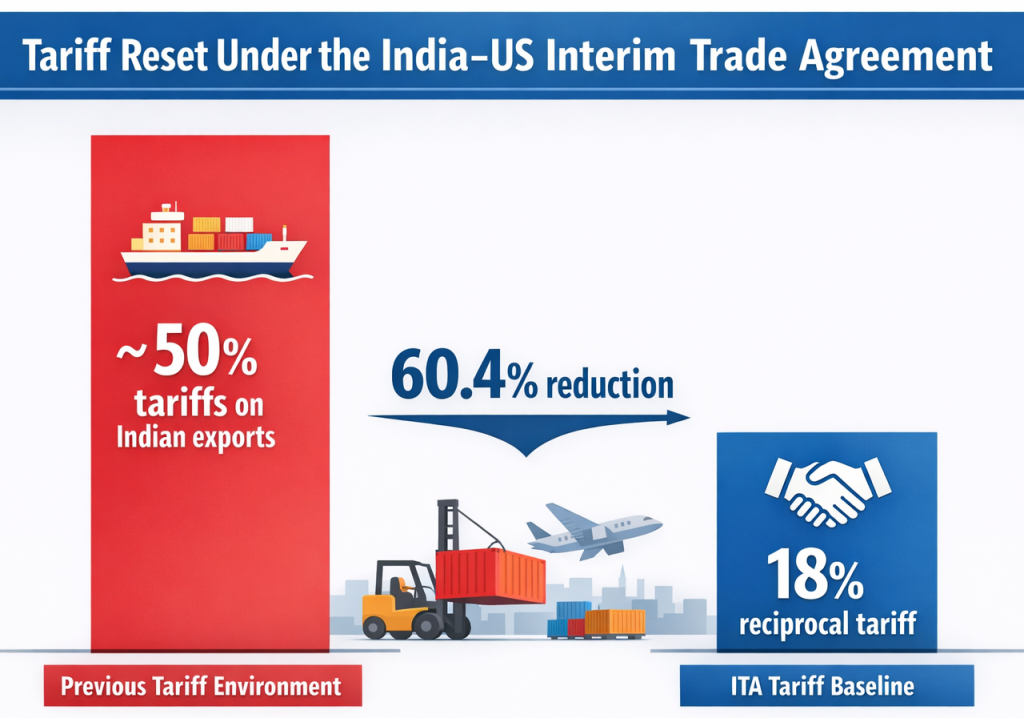
The 2026 agreement changes this trajectory. A reciprocal tariff of 18% on Indian goods has been committed by the US (White House Joint Statement, February 2026). Against the previous baseline, this is a 60.4% reduction, not a marginal move (Discovery Alert, February 2026). For procurement teams, this 18% rate carries real weight in the sourcing calculus.
It places Indian exports at a distinct advantage compared to regional peers. While nations like Vietnam and Bangladesh often face US duties near 20%, India’s new 80% rate provides a cost-effective entry point for labour-intensive sectors (BusinessWorld, March 2026).
- Textiles and Apparel: Immediate relief from high duties allows Indian garment manufacturers to regain price parity in the US market.
- Consumer Goods: Sectors including home decor, leather footwear, and artisanal products now operate under a predictable and lower cost structure.
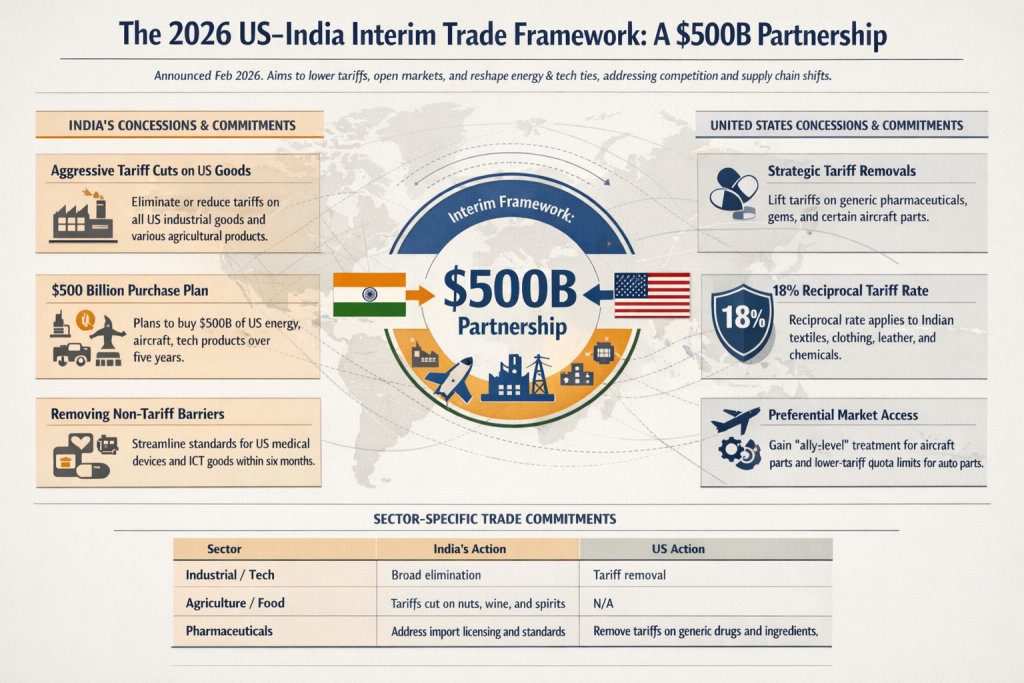
The framework also includes commitments aimed at expanding trade flows between the two countries. According to official statements, India has indicated plans to increase purchases of US energy products, aircraft, technology goods, and other industrial inputs worth up to USD 500 billion over five years (Press Bureau statement).
The Boeing effect: trust in precision engineering
While textiles provide volume, the aerospace sector provides the ultimate proof of trust. A standout feature of the 2026 deal is the ‘zero-for-zero’ tariff approach for specific high-tech sectors. Under the new framework, tariffs on aircraft parts have been reduced to 0% (Business Standard, February 2026).
The United States has also lifted additional duties on some aircraft paths previously imposed on Indian imports. Officials have suggested that this change could significantly expand industrial cooperation in aviation manufacturing.
“Already Boeing and Airbus are large buyers of aircraft parts from India. I am told both these companies are looking at India as the largest foreign OEM for parts going forward,” stated Commerce & Industry Minister Piyush Goyal (Economic Times).
Global manufacturers currently source over $2 billion worth of aerospace components and services from India annually (Economic Times, February 2026). Boeing alone has established a network of more than 325 suppliers in India, with annual sourcing exceeding $1.25 billion (Business Standard, February 2026). Airbus aims to increase sourcing of components and related services from India to USD 2 billion by 2030.
Aerospace industry outlook
India’s aerospace industry supplies components and engineering services to major aircraft programs, and global manufacturers maintain extensive engineering operations inside the country.
Aircraft production relies on thousands of specialised suppliers across machining, metals processing, electronics, and engineering services. When sourcing expands in aerospace, those supplier networks often expand across adjacent industries as well.
Wider industrial implications
Engineering goods represent one of the largest categories of Indian exports to the United States. These exports include industrial machinery, pumps, valves, auto components, electrical equipment, and precision-manufactured parts. The United States accounts for a significant portion of India’s export market across these sectors.
Even incremental tariff changes or regulatory improvements can alter cost calculations and sourcing strategies for companies building international supplier networks.
Why negotiations are moving carefully
Trade agreements between large economies rarely progress quickly. The India-US negotiations reflect this pattern as well. Several sensitive areas remain under discussion.
Prior to expanding the scope of the agreement, governments follow a phased approach when implementing sector-specific changes. In this case, data indicates that India and the US are still in the process of working towards improving market access, focusing on those non-tariff and tariff barriers that had previously limited trade flow (The Economic Times).
This interim framework has two practical purposes: to function as a testing ground by implementing targeted tariff reductions and sector cooperation. Both governments can use this particular agreement to evaluate how the arrangement affects industries before expanding the agreement further.
An emerging trade triangle
Viewed on its own, the India-U.S. trade framework appears incomplete. India is engaged in major trade negotiations with several of the world’s largest consumer markets. These conversations connect India with three major economic regions that collectively represent a large share of global consumption and industrial demand. For global manufacturers, this pattern matters.
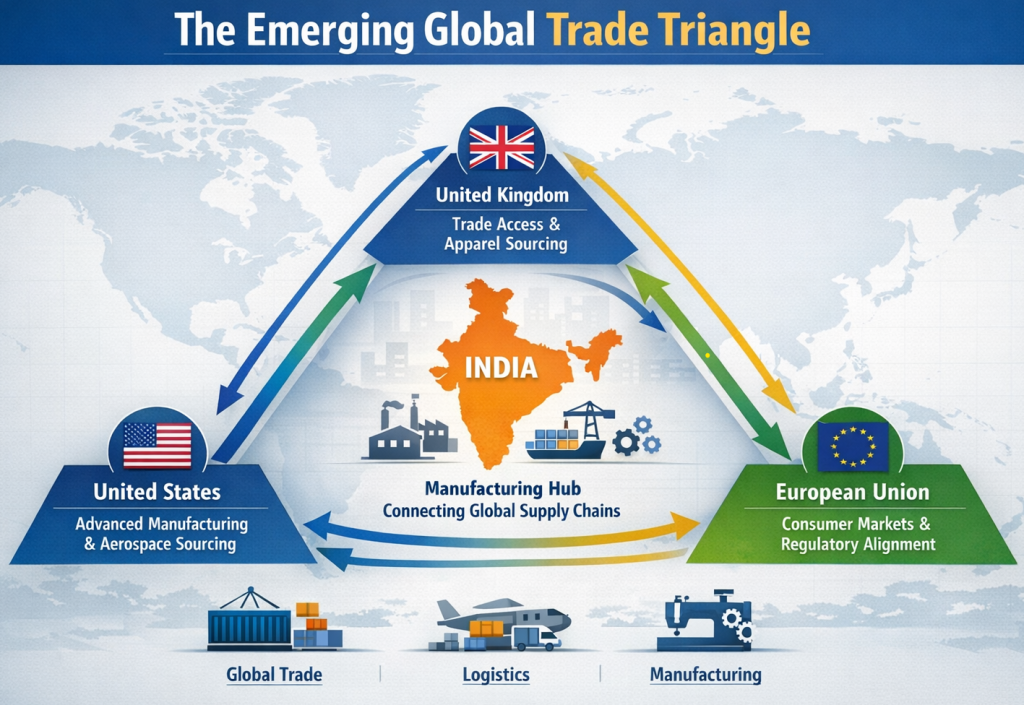
Trade agreements often determine where companies build supplier networks, and long-term production partnerships will stop when a manufacturing base gains greater access to multiple large markets; it becomes significantly more attractive for global sourcing.
Takeaways for sourcing strategies
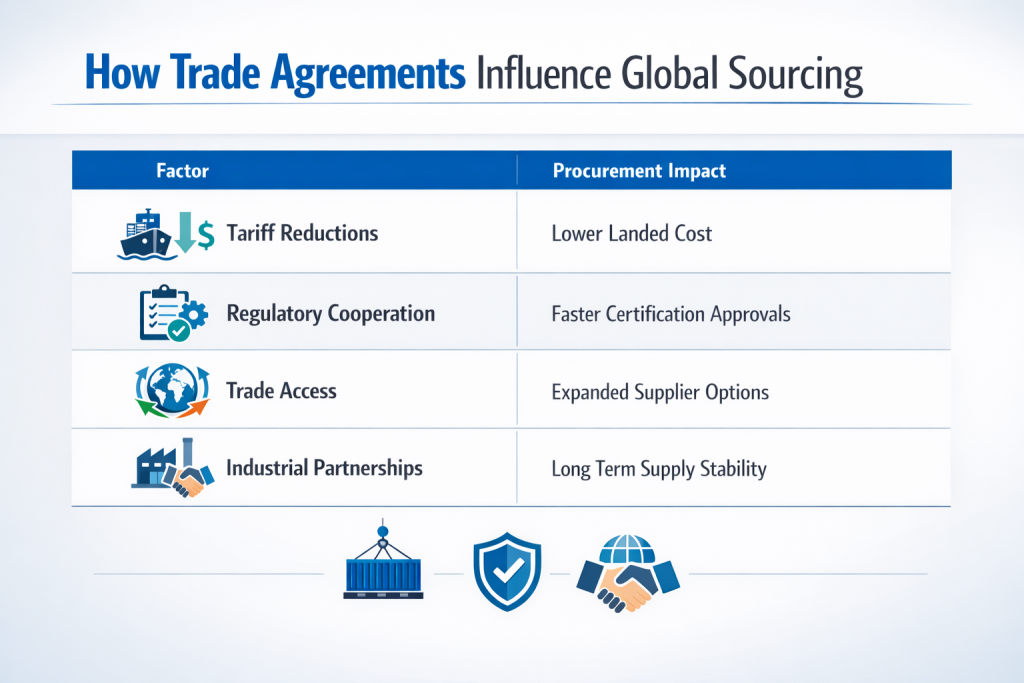
- Procurement leaders tend to track trade negotiations closely because tariffs and market access rules directly influence sourcing economics.
- Tariff reductions can change landed costs for imported components.
- Simplifying certification requirements for better regulatory cooperation.
- Supplier diversification decisions, logistics rules, long term manufacturing investments will be modified.
To get a better understanding of the full value that the US-India deal can offer, one must compare it with the recent UK and EU agreements.
- The US Path: The 18% ITA focuses on “Friendshoring” and strategic security.
- UK & EU Path: These two trade agreements prioritise regulatory and volume alignment to create a smoother route to 0 duty access for 99% of goods.
Procurement teams now have a diversified map. They can source textiles for the European market through the EU FTA and precision components for the American market through the US ITA. India sits at the centre of this triangle, speaking the language of Western standards and legal frameworks. India is now a primary vertex in a global trade triangle, offering the geographic and physical diversity that modern supply chains require.

Leave a Reply