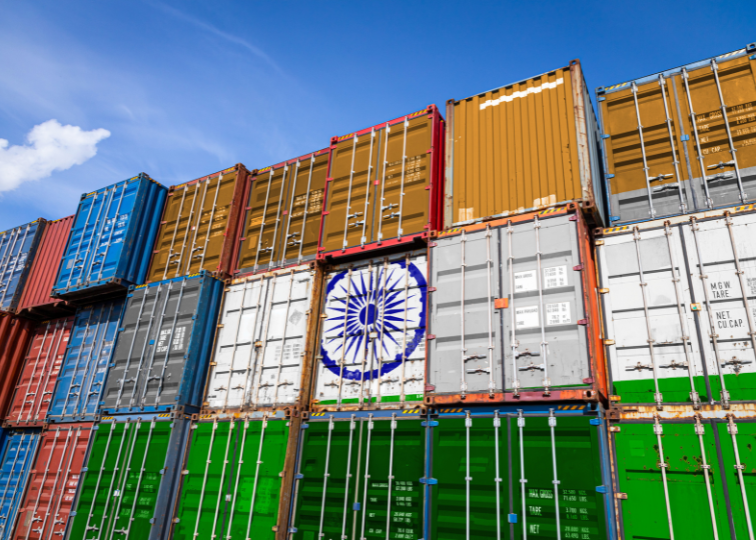
As global supply chains evolve, single-country sourcing is no longer sustainable. Procurement teams are adopting dual-sourcing – most often through a “China + India” approach that divides volume between two complementary markets. This shift allows global buyers to import confidently from India’s expanding verified suppliers base that export Indian products to global markets.
Rather than spreading production across many countries, this model focuses on two complementary bases. It helps reduce over-reliance on a single source while keeping scale, cost, and coordination under control.
The shift is driven by three key policy forces – tariffs, sanctions, and export controls – each amplifying the risk of overreliance on a single sourcing geography. For example, the United States has updated its Section 301 Tariffs regime, increasing duties on certain Chinese imports.
Simultaneously, India is emerging as a reliable second engine: supported by policy incentives, upgraded logistics, and trade agreements such as the Comprehensive Economic Partnership Agreement (CEPA), the Cooperation & Trade Agreement (ECTA), and the recent UK–India Free Trade Agreement).
These agreements not only cut tariffs but also simplify documentation and strengthen export-readiness across Indian clusters. What this means: Global buyers are increasingly treating India not just as an “emerging alternative” but as the second pillar of their sourcing footprint.
The big external push: tariffs, geopolitics rewriting the cost:risk math
Changing market realities are prompting a fresh look at sourcing choices. Let’s look at what’s driving the change:
1. New tariffs & supply-chain pressure
In September 2024 the United States Trade Representative announced final increases to Section 301 tariffs on imports from China – covering EVs, batteries, solar modules, medical supplies, and more – with rates in the range of 25 % to 100 % depending on the product category.
Earlier in May 2024 a broader expansion to Section 301 was proposed. For global sourcing teams this creates landed-cost unpredictability, stacking risk on top of base price, freight, duty, and inflation.
In that context, a second source outside the tightening China orbit becomes increasingly rational. The ripple effects of these tariffs are now being felt across multiple regions, prompting fresh risk assessments in Europe as well.
2. EU de-risking posture
The European Union has formally adopted a “de-risking” playbook, aimed at protecting its economy from strategic dependencies, promoting competitiveness, and partnering with like-minded countries.
The signal is clear: Asia-outsourced supply chains must factor in both tariff. and compliance risk, not just costs as Europe tightens its stance, other major markets are following suit with more stringent compliance expectations.
3. UK and sanctions sensitivity
The United Kingdom, for example, has taken targeted action on firms linked to Russia via several Chinese and Indian energy-trading entities, illustrating how sanction-compliance is increasingly baked into supply-chain exposure.
Collectively, these moves underscore a global shift from price-driven to policy-driven sourcing strategies. Tariff turbulence raises the value of a second source in a different policy orbit.
In other words, when sourcing from China becomes not just about cost but about contingent tariff, sanction and export-control risk, adding India as a parallel anchor becomes a de-risking imperative.
Explore verified Indian suppliers for your sourcing plans. Connect with rivexa’s sourcing team to identify export-ready partners. Start exploring suppliers.
India’s expanding capability to export indian products efficiently
While global policy shifts create external pressure, India’s internal momentum — from industrial policy to logistics and trade — is equally compelling. India’s role as a sourcing hub is strengthening, led by three major forces:
1. Production linked incentive
India’s Production Linked Incentive (PLI) scheme has attracted over ₹14 lakh crore (~US $162 billion) in committed production and created 11.5 lakh jobs across sectors, including electronics, pharma and telecom. That signals maturity in India’s manufacturing depth, compliance, and export-readiness.
2. Logistics reform
India’s National Logistics Policy is improving hubs, clearance, multimodal connectivity, and overall time and variability in delivery. These reforms lower “time-to-sourced goods” and reduce variability risk, a major pull for procurement teams.
3. Trade agreements powering India’s ability to export Indian products
These trade corridors create duty advantages and faster customs clearances, reinforcing India’s positioning as a cost-efficient, compliance-aligned partner for dual-sourcing:
- Under the India-UAE CEPA, bilateral non-oil trade reached US$38 billion in the first half of 2025, up 34% year on year.
- Under the Australia-India ECTA, over 85% of Australian goods exports by value to India are already tariff-free; 96% of Indian imports from Australia will be duty-free by early 2026.
- The UK-India FTA (agreed May 2025, pending ratification) brings clarity to the India sourcing offer for global buyers with Anglo-area procurement.
While trade ties strengthen, economic fluctuations still make headlines, but the broader sourcing logic remains intact.
Leverage India’s manufacturing ecosystem with rivexa’s verified export-ready supplier network. Contact rivexa now!
4. Short-term noise
India recorded a larger trade deficit in September 2025. But procurement logic is long horizon: dual-sourcing from India is less about day-to-day trade balance and more about structural diversification, reliability, and resilience.
These shifts make one thing clear. India has moved from a backup to equal partner in global manufacturing. India’s manufacturing ecosystem is maturing: global buyers recognise the benefits of manufacturing in India while exports of Indian products gain momentum. In sum, the external push and internal pull combine to make India the natural “second leg” for global sourcing.
How India measures up on risk controls
No dual-sourcing strategy is complete without risk management, and this is where India’s maturity is starting to show. For global buyers, dual-sourcing only works if risk controls are strong. Key levers:
1. Quality systems and certifications:
Many Indian suppliers now meet ISO norms and pass third-party audits.
2. Export documentation hygiene:
Clear HS codes, origin, duty-drawbacks, and FTA papers are essential in India sourcing.
4. Traceability & social compliance:
Global buyers expect full traceability and suppliers that meet social audit norms; India has clusters building such capability.
Compliance systems and India’s capacity to export Indian products
Customs/tax – using FTAs, duty-drawbacks – India trade deals (like CEPA, ECTA) improve landed-cost predictability. By leveraging FTA preference, HS code alignment, drawback schemes, India scores strongly for landed-cost resilience.
For global buyers, confidence in dual-sourcing hinges on predictable quality, transparent documentation, and tariff stability — three areas where India’s maturity now stands out.
rivexa as an India sourcing co-pilot
To operationalize this shift seamlessly, buyers need a structured sourcing co-pilot — and that’s where rivexa’s verified supplier-aggregator model delivers measurable control and visibility. As your “reliable co-pilot” in this journey, rivexa bridges global buyers to verified Indian manufacturers with end-to-end transaction support. Here’s how rivexa helps Indian suppliers export Indian products in apparel and industrial goods:
- Verified supplier-graph across clusters (industrial goods, home textiles, apparel) with site audits, compliance verification, and quality ratings.
- On-ground audits and sample-to-shipment QC (quality control); milestone-based order tracking.
- Transparent RFx model where buyers engage directly, with price terms clear, easy registration, and secure payments.
Finally, to ensure your dual-sourcing journey is delivering value, track the right success indicators.
Simplify dual-sourcing execution with rivexa’s verified supplier-aggregator model — track, audit, and deliver faster with transparent oversight. Contact our sourcing team here.

Leave a Reply