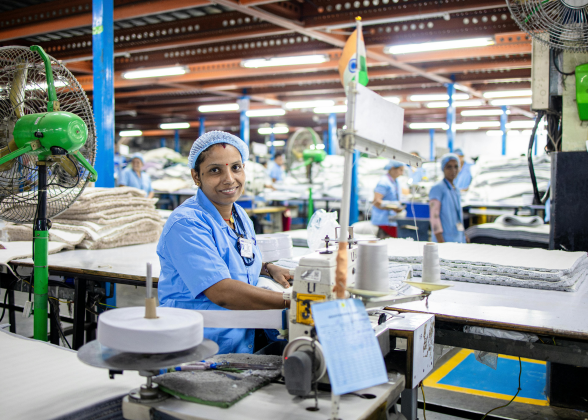
Home textile suppliers are once again in focus as UK retail shows signs of recovery after a prolonged inflation-led slowdown, with retail sales volumes growing by ~0.7% to 1.0% in late 2025. Recent updates from the Office for National Statistics indicated that easing inflation and a recovery in consumer spending are helping to restore demand across discretionary retail categories, including home furnishings and textiles.
UK inflation eased from ~11% peak (2022) to ~3% – 4% range in 2025, improving consumer spending power. For global procurement teams, this signals a gradual return to sourcing activity across home textile categories such as bed linen, bath linen, cushions, curtains, and kitchen textiles.
This is bringing sourcing markets such as India back into sharper focus. India remains one of the UK’s important home textile sourcing partners, supported by strong export capabilities in fast-moving categories such as bed linen, bath linen, and kitchen textiles.
As retailers rebuild inventory more cautiously, sourcing priorities are also becoming more closely linked to supplier reliability, sustainability capability, and long-term trade competitiveness.
UK Home Textile Market: Demand Signals to Watch
The UK home textile market remains closely linked to consumer confidence and discretionary spending. As inflation pressures ease, retailers are cautiously rebuilding inventory across home furnishings categories.
Key Demand Indicators:
- Gradual recovery in consumer spending on home furnishings
- Retail inventory restocking after conservative buying cycles
- Continued growth of e-commerce-led textile sales
India remains a vital sourcing market for UK home textiles imports, with a focus on cotton-based categories like bed linen, bath linen, kitchen textiles, and made-ups. New insights from the IBEF show that India’s exports of cotton yarn, fabrics, made-ups, and handloom products reached approximately US$ 12.4 billion in FY24, supported by established manufacturing regions and export-focused production expertise serving UK and EU retail buyers.
Home Textile Suppliers in India: Plus Points for UK Buyers
India has long been a preferred sourcing destination for home textiles. Data from the Ministry of Textiles and IBEF highlights India’s strong presence in categories such as bed linen, bath linen, and kitchen textiles.
Supported by established manufacturing centers, the country ranks among the top global exporters in these segments, with annual cotton textile exports holding at US$ 10.56 billion following a peak of US$ 12.4 billion in FY24.
Sustainability Expectations Driving Sourcing Decisions
Sustainability credentials have moved to the center of how UK retailers evaluate home textile suppliers. Buyers are placing greater scrutiny on material sourcing practices, wastewater treatment systems, chemical management processes, and supplier documentation standards.
Indian home textile suppliers serving UK and EU markets are equipped with certifications and compliance systems, such as OEKO-TEX®, Better Cotton, GRS, and ZDHC-related standards, as retailers place greater emphasis on traceability, environmental performance, and responsible sourcing practices.
On an industry-wide level, export-focused textile clusters such as Tiruppur and Panipat have also expanded investments in innovative approaches, including Zero Liquid Discharge (ZLD) wastewater treatment systems across dyeing operations, while textile recycling and circular production initiatives continue to grow in clusters such as Panipat.
Home Textile Products Commonly Sourced from India
India’s supplier base covers a wide range of home textiles categories, making it suitable for both retail and institutional buyers. This category depth allows buyers to consolidate sourcing across multiple product lines within a single category.
India-UK FTA on Home Textile Sourcing
The new free trade agreement discussions are being closely monitored across the textile and retail sectors. The removal of the standard 12% import duties on Indian home textiles alters commercial margins for UK buyers.
This change helps procurement teams update their sourcing strategies after surviving recent 11% inflationary peaks. For UK-based buyers sourcing home textiles, the agreement could create meaningful commercial advantages:
- Potential tariff reductions improving landed-cost competitiveness
- Better long-term sourcing stability across home textile categories
- Greater sourcing flexibility across cotton-based home textile products
How UK Buyers can Source More Effectively
To make the most of current market conditions, buyers need to adopt a more structured sourcing approach.
Practical Steps
- Evaluate suppliers based on production capability, not just product catalogues
- Request samples and pilot runs before scaling orders
- Plan logistics in advance to avoid delays
- Use platforms that streamline supplier discovery and coordination
rivexa Supporting Global Buyers
For buyers looking to work with Indian suppliers, having a reliable sourcing interface can simplify the process. rivexa connects global buyers with verified manufacturers across home textile categories.
It is an online B2B e-marketplace that enables sourcing of home textiles, serving as an all-in-one digital platform that facilitates end-to-end sourcing transactions. Buyers can expect support across:
- Supplier capability validation
- Visibility across sourcing stages
- Streamlined communication and coordination
Procurement teams reduce time spent on supplier discovery while maintaining control over quality and timelines.
rivexa brings this together by offering instant access to verified home textile suppliers, enabling faster, more reliable sourcing decisions. Register now and start sourcing with clarity.

Leave a Reply