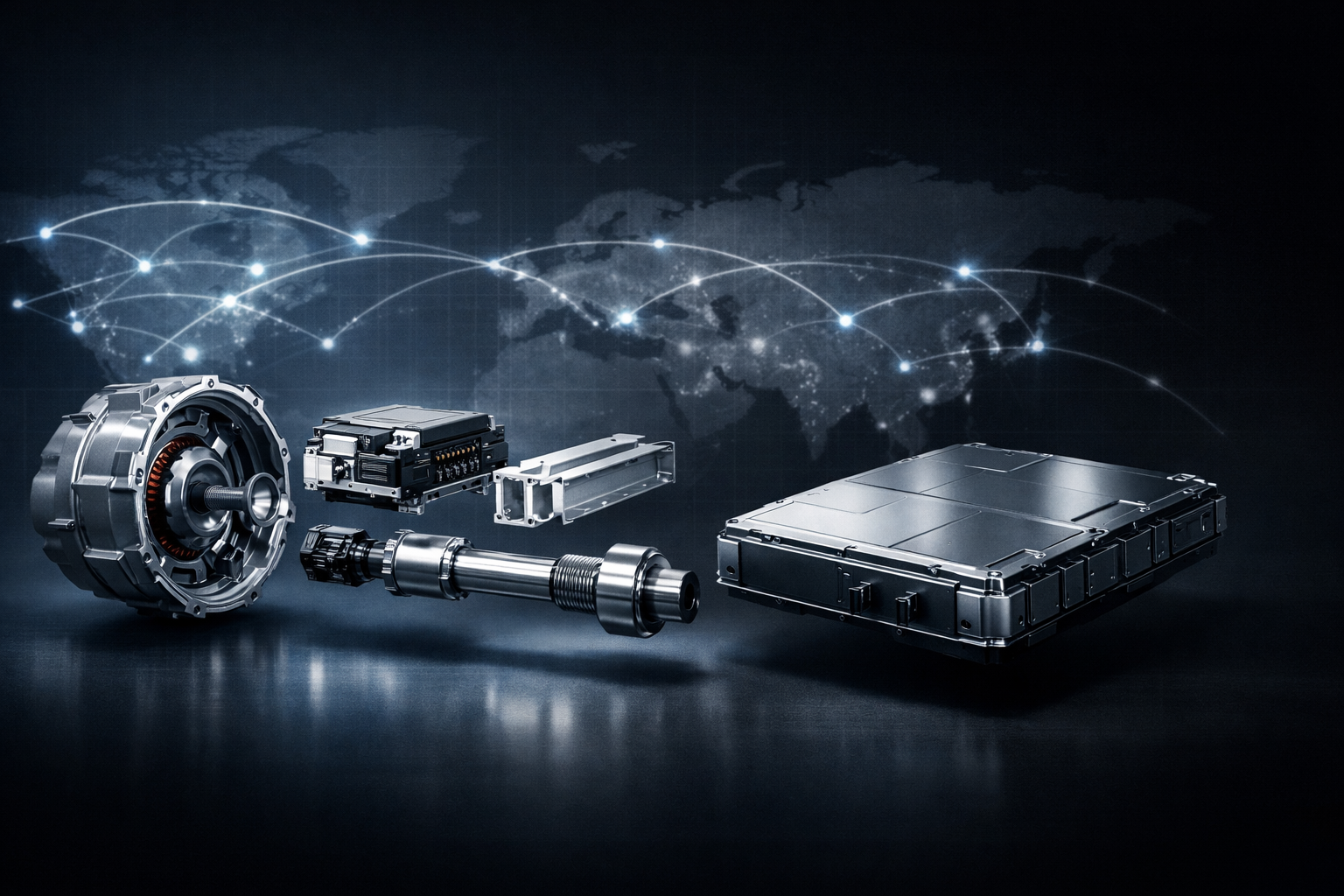
As electric vehicle adoption accelerates, the logic of automotive sourcing is being rebuilt around individual components. Industry research demonstrates that value creation in electric vehicles is increasingly concentrated in electric motors, power electronics, battery systems, enclosures, and lightweight structures. These components are sourced across international borders independently of final vehicle assembly locations (McKinsey Automotive & Assembly Insights).
Tier 1 suppliers and leading OEMs have increased their search for new, but capable sourcing destinations. Their focus revolves around export readiness, engineering depth, and high-volume manufacturing as the top selection criteria. India has positioned itself as one of these viable sourcing alternatives by prioritising on the manufacturing of EV components rather than finished electric vehicle production.
Why EV components are driving global trade growth
EV supply chains are becoming modular as OEMs separate component sourcing from final vehicle assembly to manage cost, scale, and geopolitical risk (McKinsey Operations and Supply Chain Insights). McKinsey’s EV value chain analysis indicates that more than 60% of EV value addition sits at the component and subsystem level, particularly in motors, power electronics, common battery structures, and thermal systems. (McKinsey Automotive & Assembly Insights).
As a result, global trade growth in EVs is being driven more by components than by complete vehicles, creating export opportunities for countries with established automotive manufacturing industries.
India’s EV component export foundation
The Indian component industry recorded a turnover of approximately USD 74 billion in FY20 and FY23, with exports of around USD 20 billion, according to the ACMA Annual Industry Performance Report (ACMA Research & Reports).
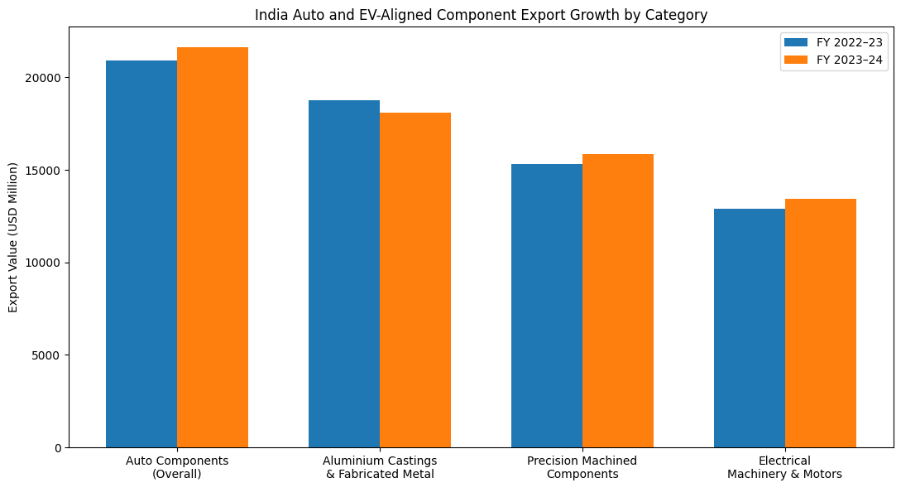
ACMA reports identified the strongest growth in EV architectures and its aligned categories, such as aluminum castings, electric motors, precision machined parts, and fabricated metal components (ACMA Research).
Drive systems and traction motors used in EVs
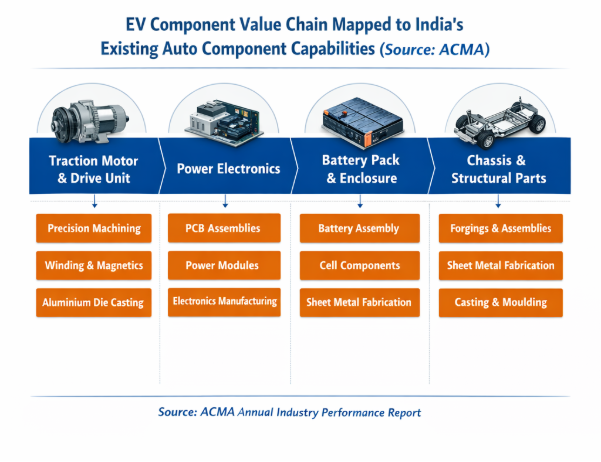
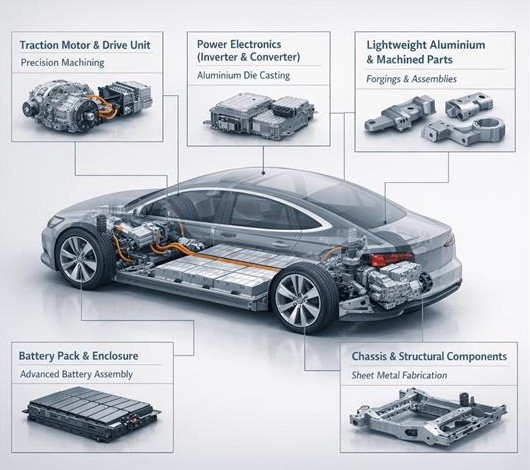
Stator housings, thermal housings, and rotor shafts are components that are installed in electric traction motors. Based on ACMA data, forging and precision machining are established Indian supplier capabilities, with motor and drivetrain applications covering both automotive and industrial segments (ACMA).
Automotive clusters in Pune and Chennai host a dense base of Tier 1 and Tier 2 suppliers with experience in tight-tolerance machining and motor-related assemblies, enabling Indian suppliers to integrate into EV motor supply chains with limited capability gaps (SIAM Statistics and Publications).
Power electronics and control system enclosures
Supply constraints are more acute in power electronics than in most other EEV segments. Semiconductor production is heavily concentrated geographically, and OEMs have responded by dual-sourcing casings, mechanical housings, and sub-assemblies to lower supply risk (McKinsey Automotive & Assembly Insights).
Indian suppliers have significantly expanded their capabilities in aluminum die casting and precision-machined enclosures used for housing automotive electronics (SIAM Publications; ACMA Research). There is a growing export base serving inverter and converter housing requirements across EV platforms.
Battery enclosures and structural EV components
Battery enclosures are among the fastest-growing EV component categories due to increasing safety and regulatory requirements. The ACMA points out battery housing as a lucrative business opportunity for Indian suppliers. Key factors supporting this identification include strengths in underbody load-bearing components, aluminum castings, and sheet metal fabrication (ACMA Research & Reports).
EEPC export data shows consistent growth in fabricated metal and aluminium component exports, categories that directly map to battery enclosure and structural EV demand (EEPC Export Statistics).
Lightweighting as a cross-cutting EV capability
Lightweighting in EV development is a critical design objective because the overall weight of the vehicle impacts its energy and range efficiency. With this in mind, global electric vehicle manufacturers prefer suppliers who can support design optimisation and lightweight materials across existing systems (Invest India Automobile Sector; Invest Gujarat Automobile Sector).
Export markets and demand signals
Consistent growth across these major EV-aligned component categories has been observed in recent global trade reports, with North America and Europe as the largest import markets (UN Comtrade Database):
| Electric motors | HS 8501 |
| Electric converters & inverters | HS 8504 |
| Motor vehicle parts | HS 8708 |
| Aluminum articles | HS 7616 |
India’s exports in these categories indicate increasing integration into global EV supply chains, supported by established engineering export capabilities and diversified destination markets. (EEPC Export Statistics; UN Comtrade Database).
What global buyers expect from EV component suppliers
EV programmes impose higher expectations on suppliers than conventional vehicle platforms. Global OEMs require PPE, P readiness, PQP alignment, traceability, and documented process control before scaling EV volumes (ACMA Research & Reports).
Many Indian auto component manufacturers already operate within these frameworks due to long-term engagement with global OEMs, providing a foundation for EV-specific expansion (ACMA Research & Reports).
Industry analysis consistently positions India as a competitive sourcing base for EV components, particularly mechanical and electromechanical systems that underpin EV performance and safety (ACMA Research & Reports; McKinsey Automotive & Assembly Insights). For global procurement teams searching for EV component manufacturers in India, the opportunity lies in component-led sourcing rather than vehicle assembly substitution.
The rivexa view
Navigating India’s EV component supplier base requires structured evaluation rather than ad hoc discovery. Platforms that connect global EV component demand with India’s manufacturing depth enable buyers to progress from pilot orders to sustained production with verified controls (ACMA Research & Reports; EEPC Export Statistics).
Data methodology note
EV component exports are identified using HS code analysis rather than explicit EV labelling. Export trends are derived from EEPC Engineering Export Statistics, and UN Comtrade data across HS 8501, 8504, 8708, and 7616. Industry capability assessments are based on ACMA annual reports, SIAM publications, and government cluster documentation.

Leave a Reply