
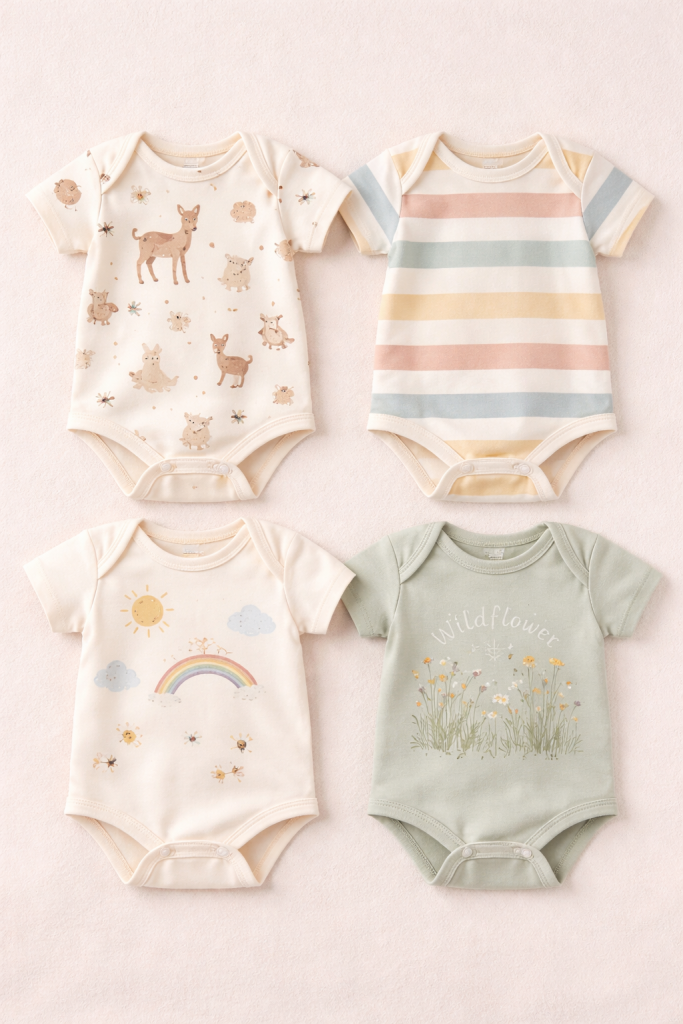
Premium children’s fashion has always occupied an unusual position within the apparel industry, particularly in organic cotton onesies. It combines the aesthetic expectations of luxury with performance requirements closer to those of technical wear. Garments must withstand frequent washing, sustained movement, and rapid growth cycles, while still delivering finish quality that reinforces brand equity season after season.
As premium kidswear brands expand their assortments and distribution across Europe and international markets, structural constraints increasingly shape sourcing decisions rather than creative ambition. European apparel manufacturing costs have risen steadily over the past decade, influenced by labour shortages, energy costs, and regulatory pressure.
According to EURATEX, labour-intensive apparel categories now face persistent capacity limitations across Western and Southern Europe, limiting the ability of brands to scale production without compromising timelines or margins (EURATEX – European Apparel and Textile Confederation, “The EU Textile and Clothing Industry” reports).
At the same time, children’s wear is subject to higher durability and safety expectations than adult apparel. Regulatory frameworks and consumer scrutiny place greater emphasis on construction quality and chemical safety, particularly for garments worn close to the skin, including categories such as organic cotton onesies.
The OECD identifies childrenswear as a category that requires heightened due diligence, reflecting the operational realities premium brands face as they scale (OECD, Due Diligence in the Garment and Footwear Sector).
These conditions have led buyers to reassess not only where they produce garments, but also how they evaluate suppliers. Increasingly, premium kidswear buyers prioritise category depth over general manufacturing capability. Factories that specialise in childrenswear tend to demonstrate a more nuanced understanding of size grading, durability requirements, and comfort considerations, which reduces rework and post-production quality issues over time.
The same sourcing discipline applies across the full assortment, including foundational items such as organic cotton onesies, where lapses in fabric behaviour and construction become visible far faster than in occasion-led styles.
Where premium kidswear quality actually comes from
Discussions about quality in premium kidswear often default to materials, but industry evidence often points elsewhere. Even in staple products such as organic cotton onesies, analysis published by McKinsey shows that construction factors such as seam strength, stitch density, and finishing quality account for a significant share of perceived quality issues in apparel. These construction elements often exceed the influence of fabric choice alone (McKinsey & Company, State of Fashion Quality and Returns Analysis).
The distinction becomes clearer when quality failures are examined in aggregate. Data from the European Commission’s RAPEX product safety alerts indicate that many quality issues in children’s wear are linked to construction and durability failures. Material origin is less frequently the source of these problems (European Commission, RAPEX Product Safety Database). For brands operating at this scale, this shifts the sourcing focus from novelty to repeatable execution.
Brands that maintain premium positioning over time typically rely on stable construction specifications and consistent supplier assignments. They also use production processes designed to manage wear, washing, and fit integrity. Quality, in this context, is not the result of isolated decisions, but of cumulative discipline applied across production cycles.

How Indian suppliers execute craftsmanship beyond the basics
For much of the industry’s recent history, brands and manufacturers framed offshore manufacturing primarily in terms of efficiency. This framing no longer reflects how premium kidswear is produced. Indian apparel manufacturing, in particular, has evolved within export markets that demand consistency, traceability, and execution at scale.
India ranks 6th among the world’s largest exporters of textiles and apparel, accounting for approximately 3.9% of global apparel trade in 2023-24 (Press Bureau Information). Strong specialisation in cotton-based garments, printed products, and embroidered apparel underpins this scale (WTO, World Trade Statistical Review). These categories are central to premium childrenswear programmes.
What differentiates Indian suppliers in this context is not volume alone, but the structure of production. This structure is especially critical for high-repeat categories such as organic cotton onesies. Industrial development studies highlight the role of apparel clusters that integrate fabric processing and garment manufacturing more closely than fragmented sourcing models allow.
This proximity allows manufacturers to maintain tighter controls over finishing quality and reduces visibility at stages where quality is most easily compromised. (UNIDO, Industrial Cluster Development in Textiles).
Over time, long-term supplier relationships further stabilise execution. OECD research shows that sustained sourcing relationships contribute to lower defect rates and more consistent quality outcomes. This is particularly in categories that require precision and repeatability, including core kidswear items like organic cotton onesies (OECD, Responsible Business Conduct in Apparel Supply Chains). In premium kidswear, this continuity allows suppliers to internalise brand-specific standards rather than treating each season as a discrete exercise.

Managing fit, finish, and seasonal continuity across factories
Maintaining fit and finish consistency across seasons remains one of the most persistent challenges in sourcing premium kidswear. Children’s clothing accounts for approximately 13.3% of the total European apparel market, according to CBI data, making fit integrity a commercial as well as an operational concern (CBI).
Industry research indicates that fit inconsistency is a leading driver of returns in children’s wear. This is particularly evident as brands scale across multiple markets and sourcing locations (McKinsey & Company, Apparel Fit and Returns Analysis). As volumes increase, even minor deviations in grading or construction can translate into measurable downstream impact.
Brands that manage this risk effectively tend to structure sourcing around repeat production programmes rather than frequent supplier rotation, an approach commonly applied to high-volume essentials like organic cotton onesies.
Quality inspection and assurance data show that brands working with repeat supplier programmes experience fewer deviations in fit and construction quality. Those shifting production between factories each season face comparatively more quality inconsistencies (QIMA, Global Sourcing and Quality Survey).
Disciplined grading systems, clearly defined tolerance levels, and sampling processes that replicate bulk production conditions reinforce fit consistency. Quality assurance guidance stresses the need to align sampling timelines and production methods. Such alignment prevents discrepancies between approved samples and final output (Intertek, Apparel Quality and Compliance Guidance).
When multiple factories are involved, leading brands apply uniform construction and finishing standards across suppliers. The brands support these standards with centralised quality benchmarks and inspection protocols. This approach allows capacity to expand without fragmenting execution standards across product categories.

When India works as a primary versus a secondary sourcing base
India’s garment exports have recorded year-on-year growth of approximately 11.3%. This growth reflects increased demand from Western buyers seeking diversified supply bases (The Economic Times). Industry analyses show that many brands adopt hybrid sourcing models.
These models combine nearshore and offshore production tactics. Nearshore for speed-sensitive styles with offshore production for repeat and volume-stable programmes (McKinsey & Company, Global Sourcing Reconfiguration).
Within this framework, India is frequently positioned as a primary sourcing base for repeat programmes such as organic cotton onesies, where process stability and consistency across seasons are commercially critical. These include cotton-based garments, print-intensive styles, and repeat seasonal programmes. Brands often retain nearshore locations such as Portugal or Turkey for limited-run collections, rapid replenishments, or styles with compressed lead times.
European trade data reflects this structural shift. While apparel imports from China have declined, imports from India have remained stable or increased across several EU markets. This indicates a rebalancing of sourcing strategies rather than short-term substitution (Eurostat, EU Textile and Apparel Trade Statistics).
Ultimately, the effectiveness of this sourcing model depends less on geography than on governance. Clear role definition within the sourcing architecture, combined with long-term alignment between brands and suppliers, determines whether brands can scale without eroding quality or consistency.

Leave a Reply