Supply chain disruptions aren’t just temporary setbacks. They can rewrite entire business plans overnight. For industrial machinery manufacturers, the stakes are even higher. Every nut, bolt, and component is tied to a larger network of raw materials, shipping routes, and buyer deadlines. When those networks break down, suppliers don’t just face delays, but risk losing trust, contracts, and cash flow.
In this blog, we will look at how disruptions have shaped the sector in recent years, what they mean for SMEs versus larger players; how India has responded, and what buyers can learn to build supply chains that are truly future-proof.
Historical Disruptions and Their Ripple Effect
Over the decades, historical disruptions and their ripple effects showed how fragile supply chains can be. This was particularly evident during the COVID pandemic, as the silence inside busy factories said it all. Machines were idle, workers couldn’t go to their workplaces, and overseas buyers were left waiting for industrial machinery parts that simply weren’t coming. Lead times for critical components stretched to three times their normal duration. For many SMEs, one delayed shipment meant lost contracts and broken buyer trust.
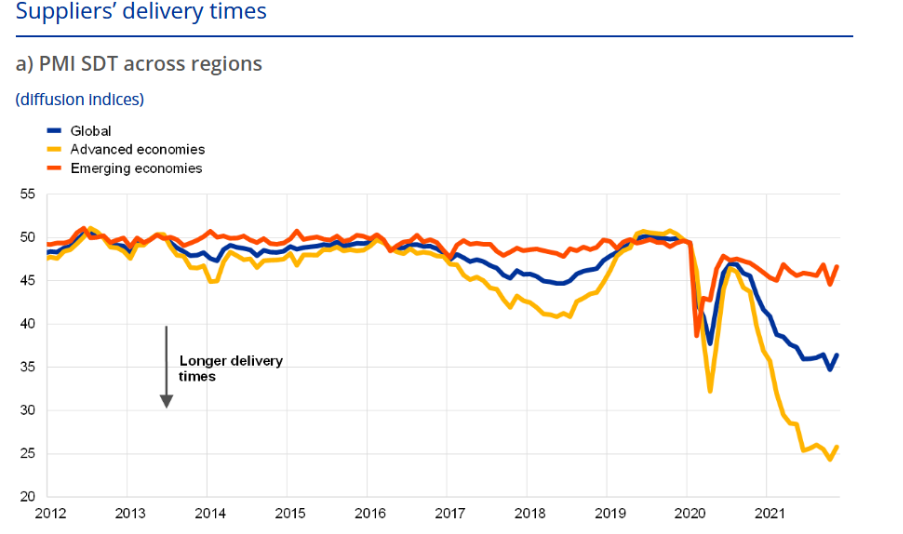
Suppliers’ Delivery Times (PMI SDT) showing global disruption patterns during the pandemic
Container Shortages & Freight Spikes
Even as production slowly resumed, the world faced another bottleneck: there weren’t enough containers to move goods. Freight prices soared 4-5x almost overnight. For smaller industrial machinery suppliers already working on thin margins, the math just didn’t add up. Some had to step away from export orders, not because they lacked buyers, but because shipping costs devoured their profits.
Trade Wars & Tariff Shocks
The US-China trade war only deepened the uncertainty. Buyers were interested in diversifying and started contacting Indian industrial machinery suppliers. However, the spike in tariffs added to the crisis. SMEs were forced to pause their contracts, and sourcing strategies kept changing. Eventually, both buyers and suppliers were left in an environment that lacked trust and consistency.
Impact on SMEs vs. Large Players
The impact of supply chain disruptions was varied across different verticals. Larger engineering firms managed to cushion the blow with their resources. However, SMEs found themselves cramped, facing challenges beyond their control.
Cash Flow Strain on SMEs
For smaller industrial machinery suppliers, the biggest pain point was cash flow. With shipments delayed and payments stuck in the pipeline, working capital dried up fast. Unlike bigger players, SMEs didn’t have deep reserves to sit on. Some couldn’t even afford to hold buffer inventory, meaning every late shipment pushed them closer to missed deadlines and unhappy buyers.
Lead Time Management
Bigger engineering machinery manufacturers managed the chaos with diversified supplier networks spread across regions. They could shift sourcing when one channel failed. However, SMEs had only a few trusted suppliers, who eventually ran into trouble. The result? Stock outs. SMEs were left with empty warehouses and frustrated customers.
Buyer Retention
Perhaps the hardest hit came in buyer relationships. When buyers saw delays pile up, many shifted orders to larger, established industrial machinery component supply firms with better risk buffers. In those moments, trust mattered more than price. Buyers were willing to pay extra if it meant reliability, and that’s where many SMEs lost ground.
Check out these statistics, they tell the story.
- Almost 94% of businesses say their revenue has taken a hit because of supply chain disruptions.
- On average, companies lose around 8% of their yearly revenue when disruptions occur.
- Each day a supply chain is down can cost a company roughly $1.5 million.
- About 43% of small businesses don’t even track their inventory, making them especially vulnerable.
- Delivery times are still about 25% longer in 2025 compared to before the pandemic.
India’s Position: Turning Disruption into Opportunity
Not every story from recent disruptions was about loss. For Indian industrial machinery suppliers, the crisis became a chance to prove resilience and agility.
1. Localized Sourcing and Agile Operations
When imports slowed to a crawl, many Indian industrial manufacturing equipment producers tapped into their domestic networks. MSMEs in Coimbatore, for example, switched from imported to locally sourced steel. The move wasn’t just about survival. It kept production running when global supply lines were clogged.
2. Policy Support & Incentives
The government of India introduced schemes like Make in India and PLI. With these, suppliers got the support required to remain competitive. Suppliers also took advantage of tax breaks and easier access to credit.
Global buyers, previously tied to Chinese suppliers, started turning to India. For buyers, that kind of consistency in chaos signalled reliability, and many of those relationships clicked.
Lessons for Buyers: Why Diversification Matters
Global procurement managers have rightly realized that their dependence on a single supplier, or a single country, is a risky bet. The recent pandemic set a real-life proof of the disruptions.
Dependence on just one geography or manufacturer became painfully obvious. Delays weren’t just inconvenient; they could also stall entire production lines.
Buyers who had spread their orders across multiple industrial machinery suppliers and regions fared much better. Even if one source faltered, production could continue elsewhere.
Strategic Supplier Relationships
It’s not just about having backups. Buyers who built strong, transparent relationships with industrial equipment suppliers, including Indian SMEs in rivexa’s network, navigated disruptions far more smoothly. Open communication, shared planning, and trust became the real differentiators. During shortages, these buyers managed to keep projects on track, satisfied clients, and often gained a competitive edge. Reliability and collaboration were more valuable than chasing the lowest price.
Future-Proofing Supply Chains in Engineering Goods
2025 is showing suppliers and buyers alike that staying reactive just doesn’t cut it any more. Real-time visibility is becoming a must. Digital tracking tools let buyers see exactly where engineering machinery shipments are and catch potential hiccups before they become crises.
Nearshoring
Nearshoring is also gaining momentum. EU buyers, for example, are no longer relying solely on traditional Asian suppliers. They’re adding Indian industrial machinery partners to the mix. It’s about proximity, reliability, and faster response times.
Risk management
Risk management is now baked into strategy. Suppliers are keeping safety stock, planning for delays, and using predictive insights to avoid downtime. Platforms like rivexa make this easier, connecting buyers with manufacturing machinery suppliers who have proven resilience, consistent quality, and the agility to handle disruptions without missing a beat.
Future-Proof Your Supply Chain
Disruptions aren’t “maybe”. They’re coming, and how you respond matters. Indian suppliers are stepping up, showing they can pivot fast, keep quality high, and deliver even when logistics are in chaos. Buyers who spread their orders and plan are the ones staying on schedule and keeping customers happy.
Platforms like rivexa are helping make that easier, connecting global buyers with suppliers who don’t just promise reliability, they actually deliver it. With the right industrial machinery partners, even unexpected hurdles won’t derail your production or your reputation.

Leave a Reply