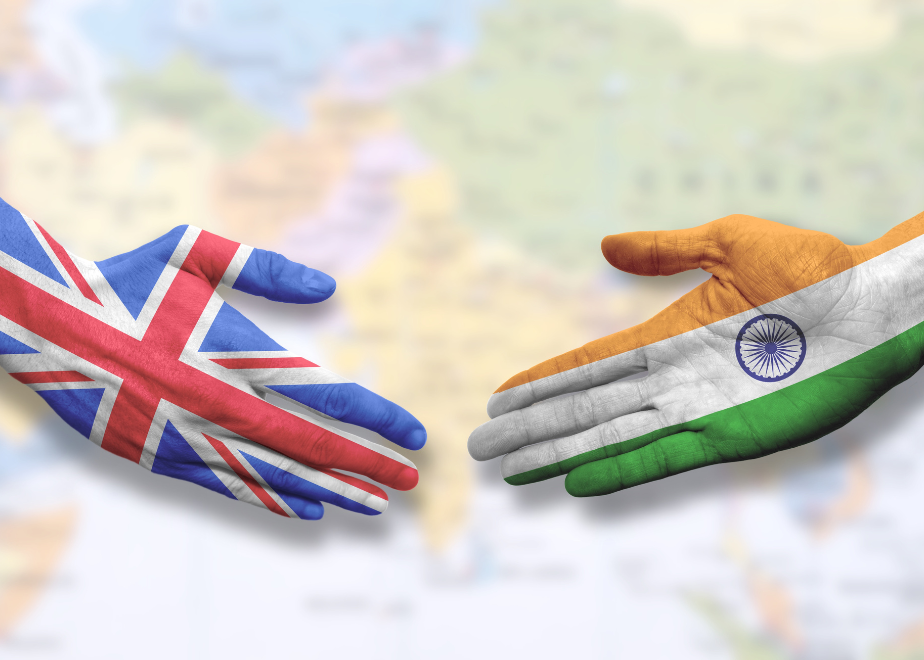
Indian Prime Minister Narendra Modi and UK Prime Minister Keir Starmer formalised the long-anticipated India-UK Free Trade Agreement in London on July 24, 2025. This is India’s first major FTA in more than a decade and marks the UK’s fourth since its 2020 departure from the EU (PIB.GOV).
After years of complex back-and-forth negotiations, both countries successfully finalised this trade pact on May 6, 2025 (India Briefing), after 3 years of negotiations.
This is a symbolic as well as strategic step forward for both countries. What began in the wake of Brexit as a diplomatic ambition has now taken shape as a full-fledged trade agreement with serious implications for global business.
For the UK, it’s a clear signal of its inclination toward high-growth markets. For India, it cements its role as a critical trade partner in the West. On the other hand, this opens doors that have been closed for far too long for Indian suppliers of custom manufacturing services for the UK.
The path to strengthening UK-India economic ties wasn’t easy. But the end result shows clearly where UK-India economic ties are headed.
Key features of the UK-India FTA
The newly signed FTA, or UK-India trade deal, is an agreement that goes beyond tariff reductions. It’s a strategic deal that covers several priorities, including:
- Goods
- Services
- Digital trade
- Investment flows
- Labor mobility
- Intellectual property
- Public procurement
As the UK-India sourcing partnership strengthens, tariffs on 95% of UK exports to India are likely to be slashed. These include Scotch whisky, cars, medical devices, and other goods. India will benefit from better access to:
- Textiles
- Pharmaceuticals
- IT services
Industrial goods suppliers from India to the UK will capitalise on this opportunity. This will especially benefit Indian contract manufacturing services, which have faced many entry barriers in Western markets.
While the UK will gain access to one of the fastest-growing economies, India will benefit from improved job-creation prospects and the scaling of its exports. The UK-India economic ties are likely to attract UK-based capital to India as well.
Both sides have set clear goals – to increase bilateral trade by over £35 billion by 2030 and create more than 1 million jobs in the UK in the Indian market.
Impact of UK-India trade deal on tariff reductions & market access
The UK-India trade deal eases challenges for exporters on both sides. The UK will remove tariffs on 99% of Indian goods. This will directly benefit sectors like jewellery, textiles, and automotive components.
On India’s side, there will be phased tariff reductions on UK exports, such as Scotch whisky, which was previously taxed at over 150%. Other categories include premium cars and high-end consumer goods.
The UK sourcing shift is expected to prioritise custom manufacturing services for B2B sourcing across home textiles, auto components, and pharma. Stronger UK-India economic ties will significantly enhance the price competitiveness of these items in the Indian market.
Sectoral growth
British automakers will gain a stronger foothold in India’s luxury segment, while Indian exporters of clothing, gems, and machinery will benefit from cost advantages in the UK market.
From machinery to finished goods, custom manufacturing services will see streamlined clearance and pricing advantages. Current UK-India economic ties account for roughly £42 billion in bilateral trade.
With this agreement in place, trade volumes are projected to grow by an additional £25.5 billion by 2040. The momentum is shifting toward India sourcing solutions for UK companies, as indigenous exporters are set to gain.
Impact on people and businesses in the UK and India
The UK-India trade deal translates into lower prices and greater variety in Indian imports for UK households. From affordable home textiles, electronics, to industrial goods, more UK procurement teams are likely to partner with Indian custom manufacturing services on contract to lower costs. UK businesses, especially in automotive and pharma, can expand exports easily thanks to reduced Indian tariffs and streamlined compliance protocols.
1. Jobs, tax revenues, and growth for the UK
In the UK, the agreement is expected to stimulate job creation in export-oriented industries, including high-tech manufacturing and spirits. Greater market access will likely fuel foreign direct investment and boost government revenues through higher trade volumes. For the whisky industry alone, this could mean hundreds of millions in additional export value over the next decade.
2. Opportunities for Indian SMEs and consumers
The UK-India FTA deal opens up access to a high-value market with over 67 million potential customers. Reduced barriers to entry and transparent procurement rules will empower a new wave of entrepreneurs ready to export.
Meanwhile, Indian consumers will benefit from enhanced access to UK products, ranging from luxury vehicles to advanced healthcare goods. At the same time, Indian garment sourcing for UK importers will significantly increase.
Strategic and economic significance of the UK-India trade deal
The UK-India trade deal marks a turning point in how both these countries approach global commerce. The agreement is projected to increase the UK’s GDP by £4.8 billion, opening access to one of the world’s fastest-growing economies.
This deal will propel India towards its ambitious goal of becoming the 3rd-largest global economy. India has set an export target of $1 trillion by 2030, proactively scaling up its trade footprint and bringing more focus on custom manufacturing services from India. Particularly, UK sourcing of apparel from India is likely to see a boost.
Key takeaways:
The UK-India trade deal removes tariffs on 99% of Indian exports and eases market entry for UK industries.
Strategic sectors like automotive, jewellery, and home textiles will see immediate commercial benefits, especially those involved in custom manufacturing services.
Strengthened UK-India economic ties could boost bilateral trade by £25.5bn by 2040 and add £4.8bn to the UK’s GDP.
Turning the policy into an opportunity
The UK-India trade deal establishes a commercial blueprint for long-term collaboration. Additionally, it’s also a catalyst for scaling custom manufacturing services that meet global standards. The policy opens up new opportunities for UK-based importers to engage with custom manufacturing services for B2B sourcing via online sourcing marketplaces.
For Indian exporters, especially SMEs, the Western economy promises tremendous potential. Industries in the UK, on the other hand, can benefit from India’s high-growth market.
As the UK-India economic ties deepen, the real winners will be businesses that move early, adapt quickly, and seize the cross-border potential. At rivexa, we help global importers connect with verified Indian B2B textile suppliers for the UK.
Get in touch with our sourcing specialists to explore Indian contract manufacturing services and what this deal could mean for you in 2025 and beyond.

Leave a Reply