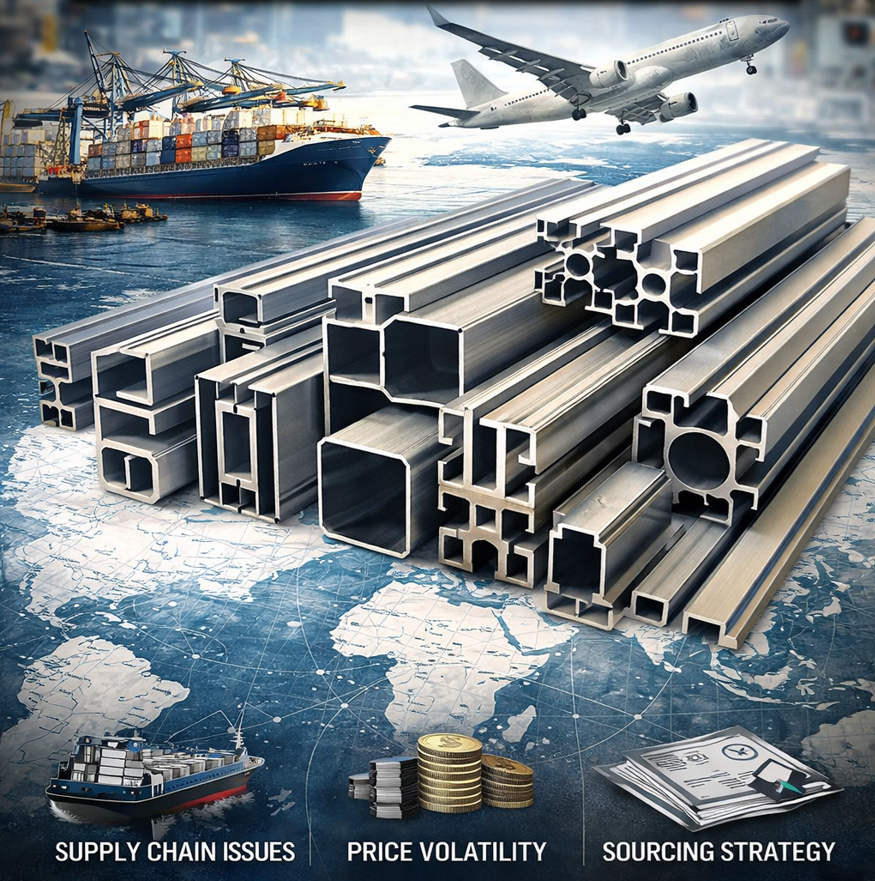
Custom aluminum extrusions are increasingly shaped by forces beyond the factory floor. Capacity changes, trade measures, and uneven regional supply influence how buyers source components. The global market is entering a phase where demand remains consistent, but supply is not evenly distributed. For buyers, this means social decisions now depend as much on market dynamics as on technical requirements.
A Large and Stable Global Market
Global demand for aluminum extrusions for use across industries like construction, transport, electrical systems, and industrial applications continues to rise. The International Aluminium Institute states that the highest demand comes primarily from transport and construction, which use these profiles in engineered, mobility and structural applications.
This matters because many of these industries rely on custom aluminum extrusions, not standard extrusions. Structural frames, inclusions, and mobility components often require tailored cross sections designed for specific works, thermal conditions, or assembly requirements.
No single sector drives demand. Multiple industries distribute these items, which gives the extrusion market a steady base. For buyers, this means competition for capacity can arise from very different sectors at the same time.
Regional Supply Gaps are Widening
In 2025 alone, Europe had imported 775,000 tonnes of extrusion products, while the US imported approximately 581,000 tonnes. Additionally, capacity pressure is becoming visible. For example, Norway’s ‘Hydro’, a major European producer, has announced plans to close multiple exclusion plants. These two signals together point to a clear pattern. Demand exists close to the buyer, but supply often sits elsewhere.
This poses a lot of structural challenges for industrial buyers, especially when they need to source custom profiles locally that require specific tooling capabilities, alloy expertise or press sizes. In this respect, it is necessary to source these items from overseas.
Trade Policy and Cost Pressures Influencing Sourcing
Cost in aluminum extrusions is no longer defined only by material and processing. Trade measures are playing a visible role. The US had raised tariffs on aluminium imports to 25%, leading to a subsequent raise in input costs as well.
In addition to this, producers even noted uneven demand conditions in their key markets located in North America and Europe. These conditions create a layered cost structure where pricing is affected by:
- Raw material.
- Processing complexity.
- Logistics.
- Tariffs and regional policies.
This makes quotation comparisons more complex. Two suppliers may offer different prices not because capability differences exist, but because they operate in different locations and structure their cost base differently.
Capacity Moving Towards Custom and High Specification Applications
Manufacturers are developing new extrusion capacity for high-performance applications across renewable energy, EVs, aerospace, and advanced industrial systems. They are also making new investments in specialised extrusion capabilities, especially for high-specification profiles.
This reflects a broader trend where growth isn’t concentrated in commodity profiles only, but is moving towards engineered, application-specific extrusions. Sectors such as renewable energy, electric vehicles, and industrial systems require:
- Better surface finishes.
- Integration with downstream processes.
- Tighter tolerances.
- Complex cross sections.
For industrial buyers, this raises the importance of supplier capability. The ability to produce a custom extrusion is not defined only by press size. It also depends on the die design, expertise, process control, and finishing capabilities.
Supply remains concentrated in Asia.
Global extrusion capacity is heavily concentrated in Asia, especially China and their role in aluminum processing and downstream items. On the one hand, it enables large-scale production and cost advantages. On the other hand, it increases dependency on a limited set of regions for supply. For industrial buyers, this often leads to a balancing act where they need to consider:
- Cost competitiveness
- Lead time reliability
- Supplier diversification
This is particularly relevant for custom extrusions, where switching suppliers is not always simple due to tooling requirements.
What industrial buyers can do next.
Buyers are now approaching the custom aluminum extrusion market and will be using a very structured approach. Their sourcing decisions must account for:
- Where capacity exists.
- How costs are structured
- Whether suppliers can handle custom requirements
This calls for a broader supply discovery and a more detailed evaluation of technical capability. It also requires design, engineering, and procurement teams to work in closer coordination, particularly when custom profiles are involved.
The practical reality of sourcing custom aluminum extrusions is this: the real challenge is identifying verified suppliers within a global network marked by uneven capacity and volatile costs.
Digital sourcing platforms are enabling the shift by connecting buyers with verified suppliers in a simpler, easier way. Such marketplaces have the right tools for supplier discovery, RFQs, production tracking, and quality monitoring, making it easier for buyers to evaluate multiple custom aluminum extrusion suppliers efficiently. Digital sourcing networks also reduce the time required to identify suppliers and initiate sampling.
Simplify custom aluminum extrusions with rivexa. Connect with the best verified suppliers that India has to offer.

Leave a Reply