In a post-Brexit scenario, UK procurement leaders are increasingly looking beyond traditional borders to build resilient, cost-effective supply chains. As of late 2025, India has emerged as a top-tier partner, recently signing a landmark free trade agreement (FTA) with the UK in July 2025. This agreement is set to eliminate trade tariffs on over 99% of Indian exports by value, making it a pivotal moment for UK firms to re-evaluate their sourcing strategies.
This guide explores the advantages of sourcing from India, how to overcome traditional hurdles, and how digital marketplaces are simplifying the ‘Proto-to-Production’ journey.
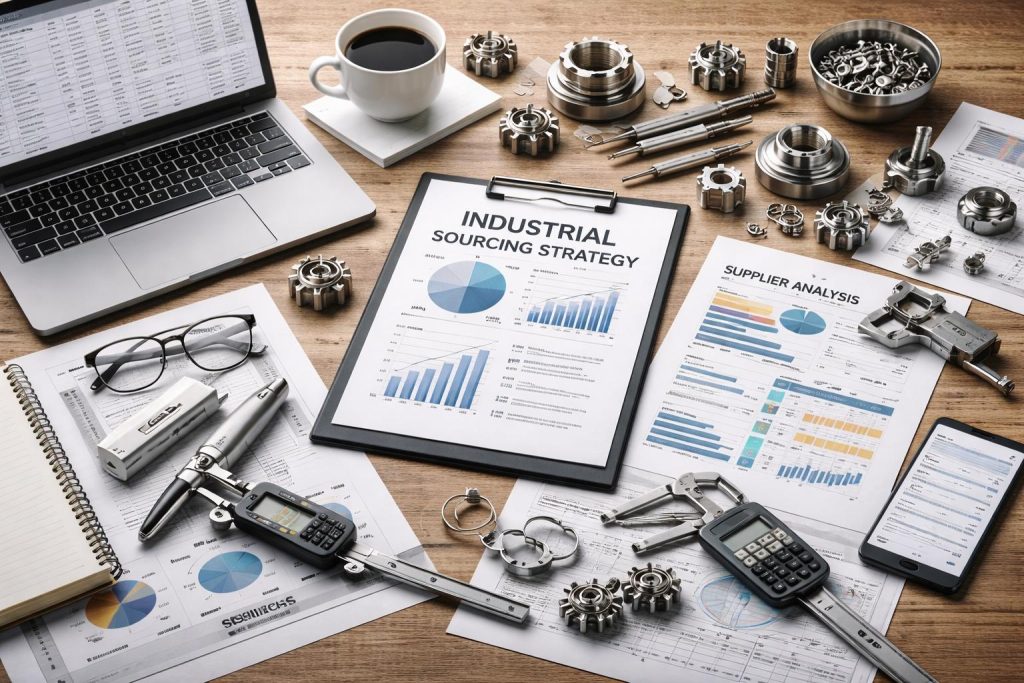
Sourcing from India
The shift towards India is driven by more than just cost. In 2025, the ‘China+1’ strategy evolved from a contingency plan into a long-term business model, with India serving as a primary pillar of the supply chain.
Economic & tariff benefits
The UK-India FTA, expected to come into force in early 2026, significantly lowers the cost of entry.
- Tariff-free access: UK manufacturers can now source high-quality industrial inputs, including EV components, castings, and machinery, with duties reduced or eliminated
- Engineering growth: Indian engineering exports to the UK and EU are projected to rise by approximately 6.7% in FY25.
- Cost efficiency: India continues to offer some of the lowest manufacturing labour costs globally, significantly lower than those in China, Vietnam, or Mexico.
Technical expertise & quality
India produces over 1.5 million engineering graduates, contributing to a deep talent pool capable of handling complex, high-precision manufacturing.
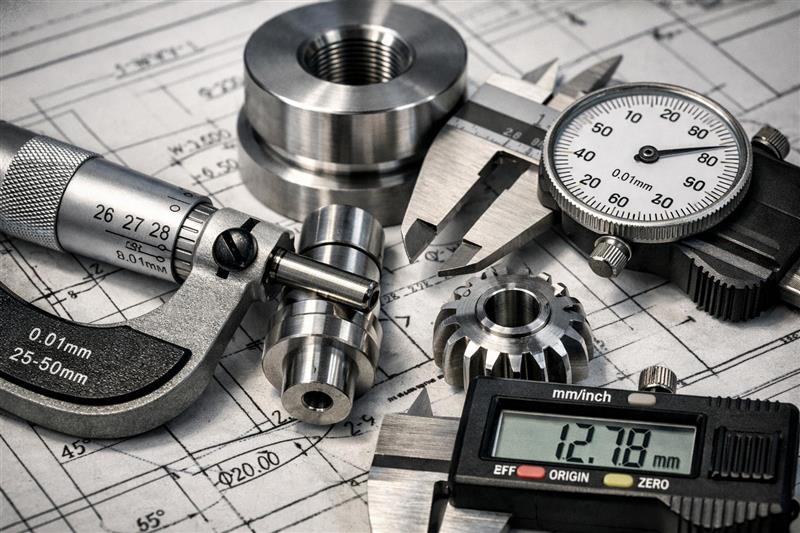
- Precision standards: Leading manufacturers maintain rigorous quality benchmarks, achieving rejection rates of < 1% and dimensional accuracy of>99% across various processes.
- Certifications: Most export-oriented Indian manufacturers are certified to global standards such as ISO 9001:2015, IATF 16949:2016 (automotive), and ATEX (for hazardous environments).
Industry-specific components that can be sourced from India
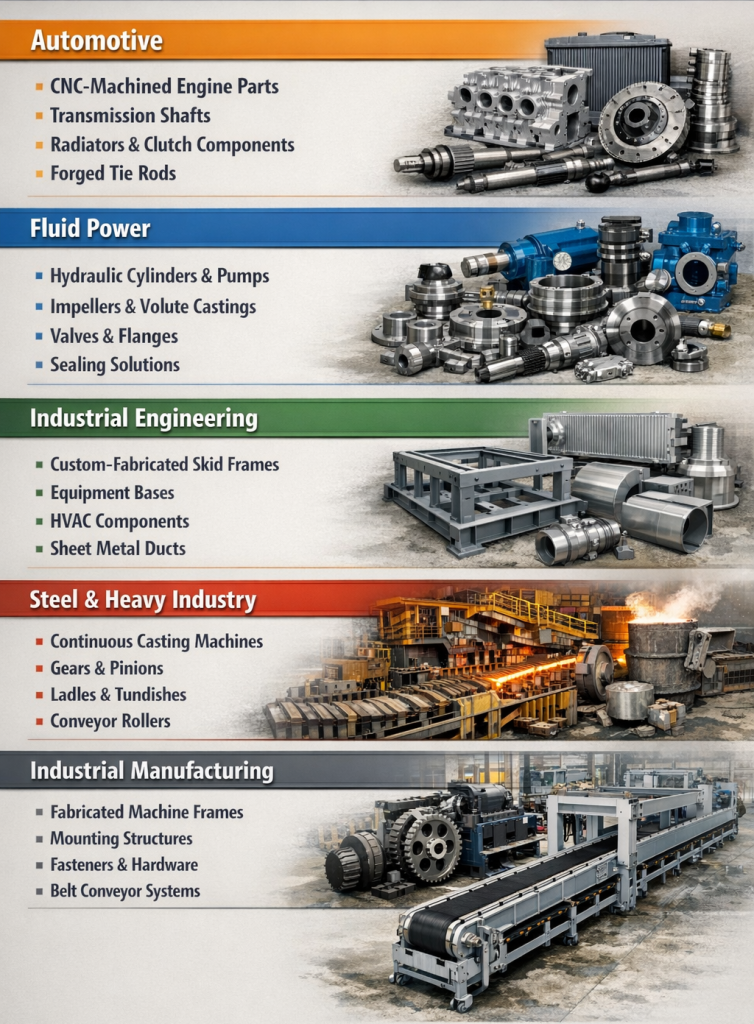
1. Fluid power and process systems
Commonly sourced components that are widely used across the UK water infrastructure, process industries, and energy-related applications include:
- Pump and pump components
- Impellers and volute casings
- Valves, flanges and fittings
- Hydraulic cylinders
- Hose assemblies and sealing solutions
2. Automotive and mobility-linked manufacturing
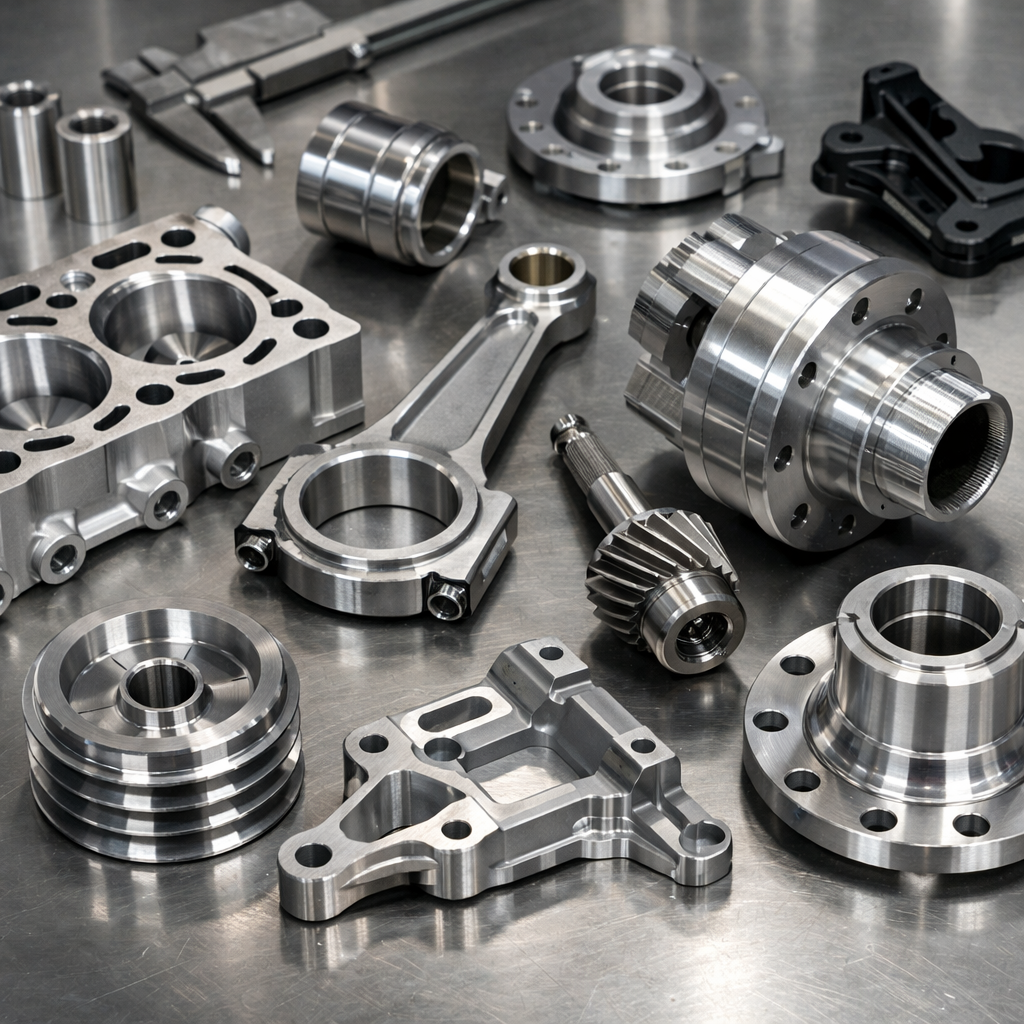
Automotive remains one of the UK’s largest manufacturing sectors, with extensive reliance on global component supply chains. UK buyers typically source:
- Sheet metal body parts
- CNC-machined engine and brake components
- Transmission shafts
- Radiators and cooling system components
- Forged parts such as tie-rods
- Suspension and steering system components
3. Steel plants and heavy industry
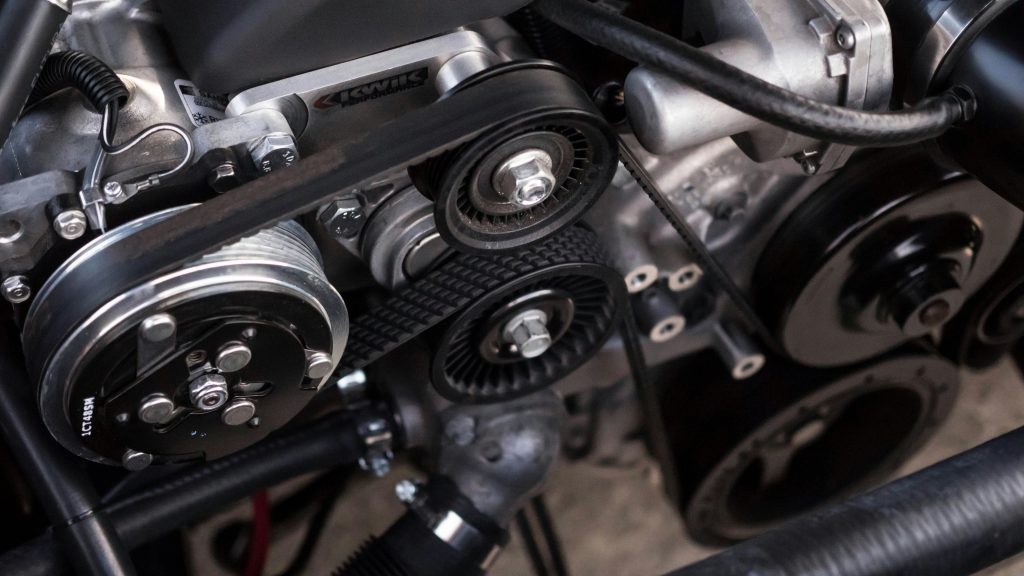
India operates large-scale specialised casting and forging centres that support heavy industrial applications in steel plants, material-handling systems, and continuous-processing environments.
- Flanges, pipe supports, and hardware
- Gears and pinions
- Ladles and tundish components
- Conveyor rollers
- Cast and forged products
- Structural frames
4. Industrial manufacturing
For general industrial manufacturing and equipment assembly, Indian supplier support:
- Fabricated machine frames and mounting structures
- Custom machine components
- Fasteners and hardware fittings
- Sheet metal enclosures
- Conveyor rollers and belt conveyor systems
5. Industrial engineering and infrastructure
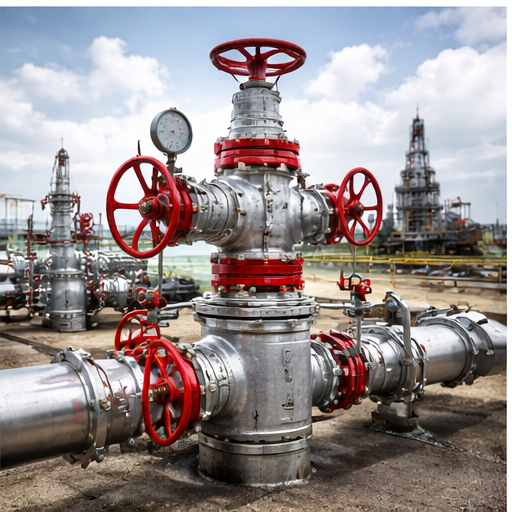
In industrial engineering and infrastructure projects, commonly sourced components include:
- Custom-fabricated skid frames and equipment bases
- HVAC components
- Valve bodies and couplings
- Sheet metal ducts
- Fasteners and sealing solutions
Manufacturing expertise and certifications
UK buyers increasingly prioritise process reliability, traceability, and audit readiness over unit cost. Export-oriented manufacturers from India commonly operate across:
- Casting
- Forging
- CNC machining
- Aluminium extrusion
- Injection moulding
- Fabrication and sheet metal work
Manufacturers in these industries hold internationally recognised certifications, including:
- ISO 9001 for quality management
- IATF 16949 for automotive supply chains
- ATEX compliance is required where applicable for hazardous environments

Common challenges in international component sourcing
While the benefits are clear, the UK has historically faced challenges that can be mitigated through the right approach:
1. Fragmented supplier base
India has a fast-growing base of SMEs. Finding the right fit requires intensive due diligence on technical capability and financial stability.
2. Logistics and infrastructure
While India has expanded its dedicated freight corridors and port capabilities in 2025, navigating local logistics can still be complex.
3. Cultural and time zone gaps
Differences in business practises can lead to communication delays if not managed through a centralised platform.
Simplifying trade through digital sourcing
Managed B2B marketplaces and digital sourcing platforms like rivexa solve these issues by acting as a single point of accountability. These platforms pre-verify manufacturers, provide real-time production monitoring, and handle the complexities of ‘Proto-to-Production’ under a single NDA. Digital sourcing also simplifies compliance, ensuring that all suppliers meet UK-specific ESG and IP protection standards.
A digital sourcing layer for sourcing success
rivexa is a one-stop digital platform that bridges the gap between UK buyers and over 700 verified Indian manufacturers. By providing end-to-end support, from initial design and prototyping to final dispatch, rivexa ensures a seamless procurement experience with a focus on IP protection and on-time delivery. An initiative by mjunction services limited, a joint venture of Tata Steel and SAIL, rivexa is the digital route to simplified drawing-based sourcing supported by technical expertise and real-time monitoring.

Leave a Reply