Global automotive supply chains are undergoing a deliberate rebalancing. Cost competitiveness remains essential, but it is no longer sufficient on its own. OEMs and Tier 1 suppliers are now prioritising resilient, engineering depth, and supplier continuity across geographies.
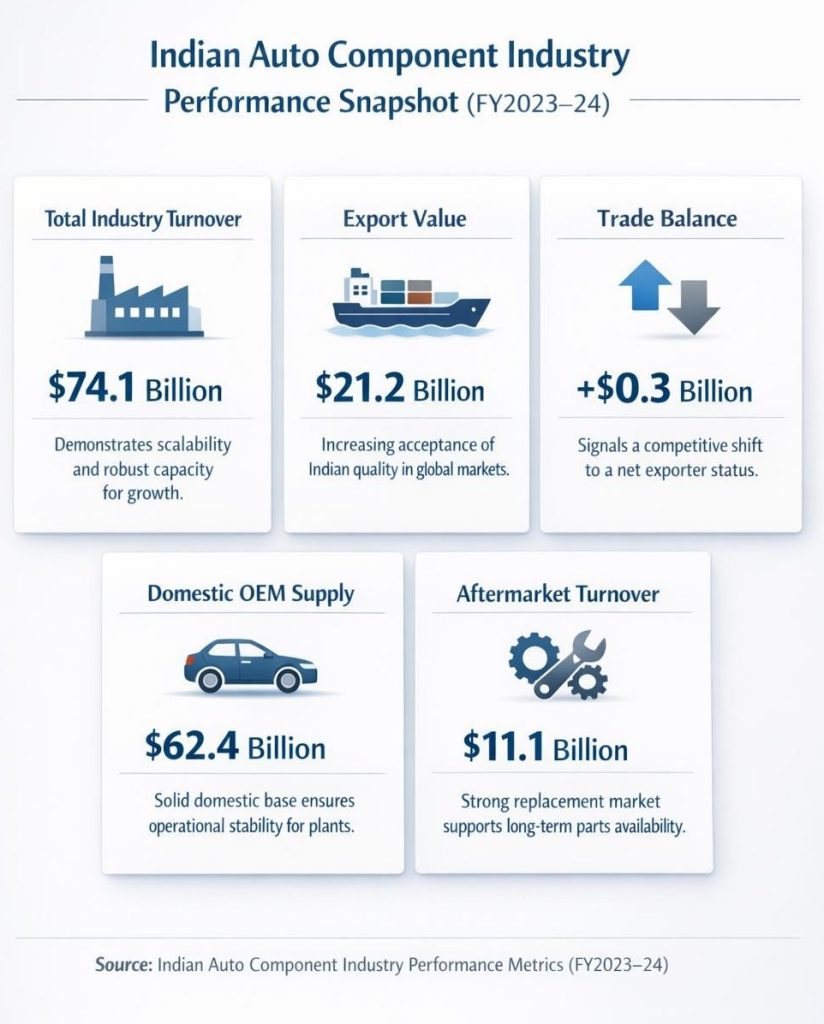
The Indian auto components sector, valued at approximately USD 74.1 billion in fiscal year 2023-24, has grown by 9.8%, defying global economic headwinds and geopolitical volatility. This expansion is driven by a sophisticated synergy of robust domestic demand, targeted industrial policy, and a burgeoning reputation for engineering excellence.
As global OEMs seek to diversify their supply chains under the ‘China+1’ paradigm, India’s unique combination of democratic stability, vast technical talent pool, and rapidly improving infrastructure network has positioned it as the world’s fastest-growing export base.
A quantitative foundation: mapping the industry’s growth
The performance of the Indian auto component industry over the last five years provides a quantitative testament to the country’s industrial maturity. In fiscal year 2023-24, the sector recorded a turnover of USD 74.1 billion (INR 6.14 lakh crore), nearly doubling in size over the past half-decade with a CAGR of approximately 14% (3).
This growth is not an isolated phenomenon confined to domestic consumption; exports have become a vital pillar of the industry’s growth, reaching USD21.2 billion in FY24, a 5.5% year-on-year increase. What really drives this momentum is a trade surplus of USD 300 million, even as broader global merchandise trade remained subdued. Current projections from the Automotive Component Manufacturers Association of India (ACMA) indicate the industry is on track to reach a valuation of USD 200 billion by 2030.
The industry is divided into organised and unorganised segments, with the organised segment focusing on high-value precision instruments and components for global OEMs. Domestic supply to these OEMs grew by 8.9% to USD 62.4 billion in FY24, driven by a market shift toward larger vehicles, particularly SUVs, which require higher-value-added components.
This domestic scale provides the necessary demand spine, enabling manufacturers to achieve the learning effects and utilisation rates required for global competitiveness. As consumer preferences shift toward more powerful, feature-rich vehicles, minimum component complexity standards have increased, necessitating upgrades to manufacturing capabilities across the supplier base.
The data suggests a trend towards geographical resilience. While European exports stayed at the previous year’s levels in the first half of FY25 due to regional economic slowdowns, North American exports grew by 8.3% (7). The ability to switch between major global markets based on regional demand cycles is a critical advantage for Indian suppliers, who are increasingly adept at meeting the distinct regulatory and quality standards of different continents.
India’s geopolitical resilience
The realignment of global trade corridors is arguably the single most significant external catalyst for the Indian automotive sector. McKinsey estimates that between USD 12 trillion and USD 14 trillion in global trade will shift across corridors by 2035 due to geopolitical and structural changes.
In this volatile environment, India is emerging as a ‘trusted partner’, benefiting from its diplomatic convergence with major Indo-Pacific partners and its role as a Vice-Chair of the Indo-Pacific Economic Framework (IPEF) Supply Chain Council.
The entry of major global OEMs like Mercedes-Benz, which designates India as a ‘best cost country’ within its global team, signifies a shift in perception. It is an acknowledgement that the cost advantage is now married to a high level of engineering skill and a supplier base capable of meeting world-class specifications. Michael Moebius of Daimler India Commercial Vehicles (DICV) chose this mix by highlighting the combination of low costs, high levels of education, and an agile, young workforce.
Global export footprint and product specialisation
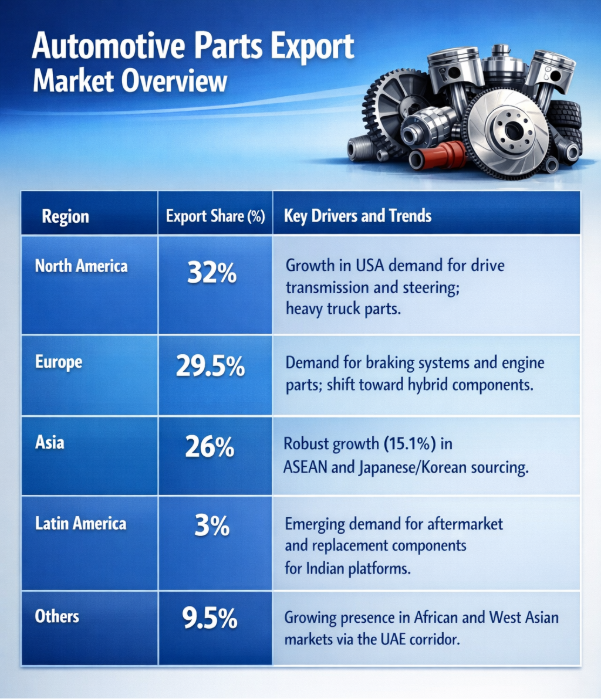
India’s export footprint has expanded both in volume and geographical breadth, with total exports reaching USD 22.9 billion in FY25, and 8% increase from the previous fiscal year. North America and Europe remain the primary destinations, collectively accounting for over 60% of total exports.
- North America holds a 32% share
- Europe accounted for 33% in FY24
- The Asian market accounted for 15.1% in FY25
The current output to OEMs is led by high-value categories:
- Engine components: 26% share of OEM supplies
- Suspension and braking systems: 15% of total production
- Drive transmission and steering: 13% share, reflecting high global demand
India has successfully specialised in ‘Group 2’ components comprising high-value parts that are frequently outsourced, like gearboxes and chassis. This mix distinguishes India as a hub for complex systems engineering rather than just a source for low-value consumables or simple assembly.
Strengthening the export backbone: logistics and quality
India is dismantling trade barriers by integrating high-speed infrastructure with global quality standards. Through the National Logistics Policy and Dedicated Freight Corridors (DFCs), which saw a 48% surge in operations in FY25, transit times to ports like Mundra have been halved (Simplique). This efficiency is highlighted by “Truck-on-Train (ToT) services for auto parts and the commissioning of the country’s largest in-plant automotive rail siding at Manesar, supporting the movement of 450,000 units annually.
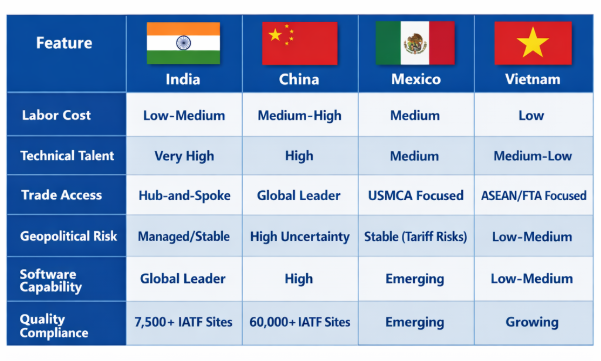
Accompanying this speed is a rigorous commitment to quality: with 7,541 IATF 16949-certified sites, India ranks second globally in certification volume, ensuring that Indian-made components meet the stringent precision and safety benchmarks required by top-tier global OEMs (ACMA).
With a trade surplus, record-breaking engineering exports, and a massive investment pipeline under PLI schemes, India has become a global export base for automotive components. Global buyers engaging with Indian suppliers are securing partnerships with a reliable, transparent, and innovative ecosystem that supports the most complex global supply chains.

Leave a Reply