The steel industry contributes an estimated 7-9% of global CO₂ output, averaging approximately 1.92 tons per ton of steel produced. This emissions profile has made sustainable steel a material factor in sourcing decisions. As global emissions disclosure requirements intensify, buyers are recalibrating their supplier selection criteria to meet evolving regulatory and customer mandates.
ESG standards that previously influenced long-term strategy now determine whether suppliers advance past initial qualification stages. For sourcing teams managing strategic relationships, supplier selection increasingly hinges on documented decarbonisation capabilities and compliance-ready reporting systems.
The green turn in global steel
Decarbonisation targets are accelerating the adoption of low-carbon steel and the transition to sustainable steel production, faster than initial market forecasts anticipated. Demand for low-carbon steel is projected to reach 179 million tons by 2050; a trajectory that’s already influencing procurement specifications and supplier qualification criteria today.
OEMs across the machinery, automotive, and industrial sectors are tightening carbon-intensity requirements for component inputs, creating immediate sourcing challenges. India, with an annual crude steel production capacity of approximately 120 million tons, is responding with infrastructure investments and process upgrades designed to meet these evolving buyer standards.
Regulatory engines behind India’s sustainable steel transition
India’s policy framework is playing a central role in accelerating sustainable steel production. The Government of India’s National Green Hydrogen Mission (2023) is designed to decarbonise hard-to-abate sectors, including the steel sector. It supports pilot projects that replace coal with hydrogen in iron-making processes such as direct reduced iron (DRI) production (Ministry of New and Renewable Energy; Ministry of Steel). These initiatives are intended to help mills reduce emissions intensity while maintaining industrial-scale output (PIB).
This effort is complemented by India’s Green Steel Policy, which establishes reference standards for low-carbon steel. The policy encourages alignment with international climate frameworks, including those emerging in the European Union (Ministry of Steel). The Ministry of Steel has proposed a budget allocation of ₹15,000 crore in 2025 to incentivise low-carbon steel production in India.
At the operational level, state governments are offering incentives to adopt renewable power across steel plants, including solar, wind, and biomass integration (MNRE). In parallel, the Perform, Achieve, Trade (PAT) scheme under the Bureau of Energy Efficiency (BEE) provides market-linked incentives for energy efficiency improvements. This framework reinforces the regulatory and economic foundation supporting sustainable steel production in India (PAT). For instance, mills earn tradable certificates when they meet defined energy-efficiency targets.
| Year / Period | Crude Steel Production (MnT) | Finished Steel Production (MnT) | Finished Steel Consumption (MnT) |
|---|---|---|---|
| 2019–20 | 109.14 | 102.62 | 100.17 |
| 2020–21 | 103.54 | 96.20 | 94.89 |
| 2021–22 | 120.29 | 113.60 | 105.75 |
| 2022–23 | 127.20 | 123.20 | 119.89 |
| 2023–24 | 144.30 | 139.15 | 136.29 |
| Apr–Oct 2023 | 82.47 | 79.13 | 76.01 |
| Apr–Oct 2024 | 85.40 | 82.81 | 85.70 |
Indian mills adopting low-carbon technologies
Indian steel producers are increasingly moving away from single-route production models towards diversified, lower-carbon technology pathways. While blast furnaces continue to operate across many integrated plants, their emissions intensity remains high at roughly 2.6 tons of CO₂ per ton of crude steel.
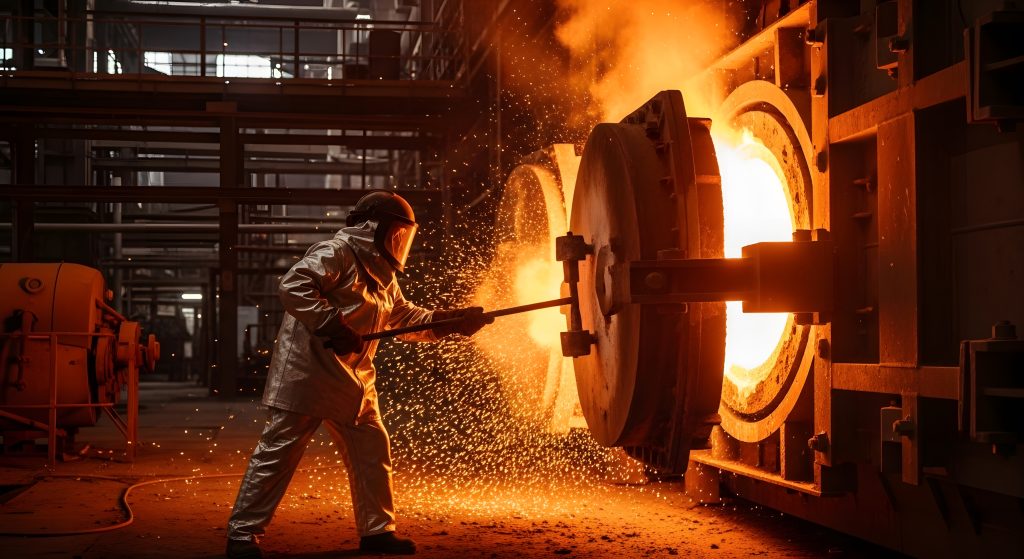
This has prompted producers to progressively reduce their reliance on this route (World Steel Association; International Energy Agency). As a result, mills are expanding the use of Electric Arc Furnaces (EAFs) and Induction Furnaces, while evaluating transitional solutions for legacy assets.
1. Electric arc furnaces
EAF-based steelmaking relies heavily on scrap and offers significant environmental benefits. It can reduce direct emissions by 60-85% compared with traditional blast-furnace routes, depending on the electricity mix (IEA; World Steel Association).
2. Induction furnaces
In parallel, mid-sized producers are increasingly turning to induction furnaces (NITI Aayog). These furnaces eliminate the use of coke or coal and enable emissions reductions without large-scale plant redesign (Ministry of Steel).
3. Hydrogen-based DRI
Hydrogen-based Direct Reduced Iron (H₂-DRI) Projects are underway, with Tata Steel completing pilot trials to replace coal with hydrogen in iron reduction processes (Tata Steel Sustainability Disclosures).
JSW Steel and AM/NS India have announced similar pilot programmes as part of their long-term decarbonisation roadmaps. All of these initiatives align with the stated net-zero targets before 2050 (JSW Group Sustainability Reports; AM/NS India Climate Commitments).
Sustainable metallurgy: from material to market
India’s transition towards sustainable steel production extends well beyond primary steelmaking into downstream processing, logistics, and disclosure practices. For global buyers, this broader shift across the value chain is increasingly where differentiation lies.
Cleaner, low-emission logistics
At the logistics and fabrication level, steel producers are reducing emissions by redesigning material movement and outbound transport. Several large mills are integrating LNG-powered trucking, electrified conveyors, and rail-linked evacuation to lower diesel dependence and reduce idling losses within plant boundaries (IEA; Ministry of Steel). These measures support lower Scope 1 and Scope 3 emissions associated with finished steel deliveries (IEA).
Eco-certified coatings for finished steel
Downstream manufacturing processes are also evolving. Export-oriented producers are adapting eco-certified surface treatments and coatings that meet environmental and occupational safety standards required in the EU and GCC markets (ECHA).
These coatings are applied to sheets, fabricated parts, and industrial assemblies. They are designed to eliminate hazardous substances while maintaining corrosion resistance and performance specifications (European Chemicals Agency; IEA).
Building audit-ready traceability in steel production
Traceability has become a central requirement rather than an optional capability. Many Indian mills now deploy digital traceability systems (World Steel Association), including batch-level tagging and carbon accounting tools, to track steel from raw material input through final dispatch.
This level of documentation is increasingly critical for exports to the European Union under the Carbon Border Adjustment Mechanism (CBAM), where verified emissions data determines compliance exposure (European Commission). Similar expectations are emerging across GCC markets, making traceability a commercial requirement for export buyers rather than a reporting exercise.
ESG reporting that holds up to global scrutiny
At the disclosure level, large Indian producers are aligning operations with globally recognised ESG reporting frameworks such as GRI and SASB. These frameworks require independent assurance of emissions intensity, energy efficiency improvements, and renewable power usage. They also mandate verification of Scope 1, 2, and 3 emissions (World Steel Association).
How buyers can leverage India’s decarbonisation momentum
India’s decarbonisation efforts are translating into tangible procurement advantages for global buyers. As Indian mills adopt lower emission production routes and improve energy efficiency, buyers sourcing sustainable steel from India can directly reduce upstream Scope 3 emissions associated with raw material inputs (International Energy Agency; World Steel Association). This reduction is particularly relevant for automotive, construction, and industrial OEMs, where supplier ‘carbon-intensity’ is now a formal valuation metric in annual audits.
A growing share of Indian steel producers operating in the export market use ISO 14001 environmental management systems. They also comply with energy efficiency benchmarks under national and international frameworks (Bureau of Energy Efficiency). These certifications simplify supplier onboarding and support ESG disclosures required by buyers in Japan, North America and the EU.
The road to net-zero steel
India’s green steel transition reflects a pragmatic balance of technology adoption, policy support, and industrial scale. Investments in low-carbon production routes and renewable energy integration are changing the emissions profile of Indian steel production. Verifiable ESG reporting now reinforces India’s position as a reliable sourcing base for decarbonising global supply chains.
As regulatory frameworks come into focus and buyers place greater weight on emissions transparency, India’s progress in sustainable metallurgy is increasingly significant. This progress positions India as a long-term sourcing partner for sustainable steel.
By modernising furnaces, improving efficiency across the value chain, and aligning with global compliance standards, India is reshaping its steel industry. It is also changing how global procurement strategies approach the path to net-zero.
Translate sustainability goals into compliant component sourcing. Connect with rivexa now.

Leave a Reply