Buyer expectations in kidswear manufacturing have evolved dramatically compared to even a few years ago. Strengthened regulatory requirements, heightened product safety standards, and greater supply chain traceability demands have altered how suppliers of children’s apparel are vetted. Procurement teams now prioritise documented compliance frameworks, auditable process controls, and supply chain transparency over unverified supplier representations.
In response to ongoing global uncertainty, procurement professionals are adopting verified sourcing models as practical tools to control risk, maintain production consistency, and support scalable kidswear programmes.
Why trust outweighs prices in kidswear sourcing
Children’s apparel remains one of the most tightly regulated segments in global fashion sourcing. Safety regulations covering chemical content, mechanical design, flammability characteristics, and labelling requirements are becoming more stringent across key import markets, including the EU, UK, United States, GCC regions and Oceania. Regulating agencies increasingly require prospective, evidence-based compliance rather than post-shipment declarations.
Global buyers also confront uneven supplier performance across sourcing regions. Communication breakdowns, missed production targets, and variable quality execution often emerge only after orders commence. These operational difficulties are intensified by sustained freight instability and geopolitical tensions, which have reduced the window for effective corrective action.
In response, procurement teams are shifting away from fragmented supplier discovery to verified sourcing models that emphasise supply chain transparency and execution predictability, particularly in children’s categories, where tolerance for operational variance is inherently narrow.
The impact of apparel safety standards on global sourcing
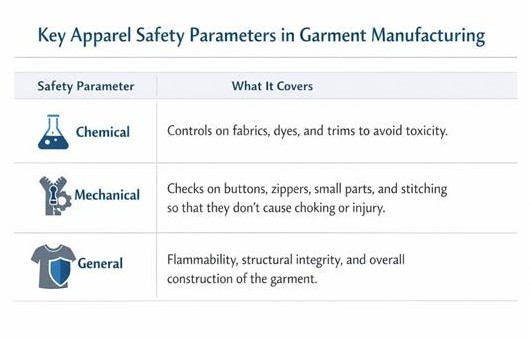
The Bureau of Indian Standards is in the process of formulating a “Textiles – Children Apparel Safety Specification” (TXD 20 (27312)), which consolidates requirements around chemical exposure, mechanical safety, and overall garment construction. It aligns with international approaches to children’s Product Safety and reflects India’s intent to standardise expectations for export-oriented kidswear manufacturing (BIS; PIB).
This regulatory intensification aligns with broader development across primary import destinations. The European Union’s REACH regulation continues to expand the list of prohibited substances for textiles. At the same time, the US Consumer Product Safety Commission (CPSC) enforces binding limits on lead content, flammability, and small parts on the Consumer Product Safety Improvement Act (CPSIA).
Equivalent product safety and labelling mandates are in effect across the UK, GCC territories, and Australia, thereby amplifying compliance obligations for global procurement teams sourcing children’s apparel (European Commission; CPSC; UK OPSS).
What ‘verified sourcing’ means in kidswear sourcing
Verified sourcing in children’s apparel has evolved into a structured risk management framework that extends beyond factory audits. Regulators now expect buyers to demonstrate due diligence across the entire supply chain, not only at final inspection points.
The European Commission’s requirements under REACH and the EU General Product Safety Regulation (GPSR) position importers as responsible parties for ensuring that children’s products remain compliant across the whole supply chain, not just at final verification points.
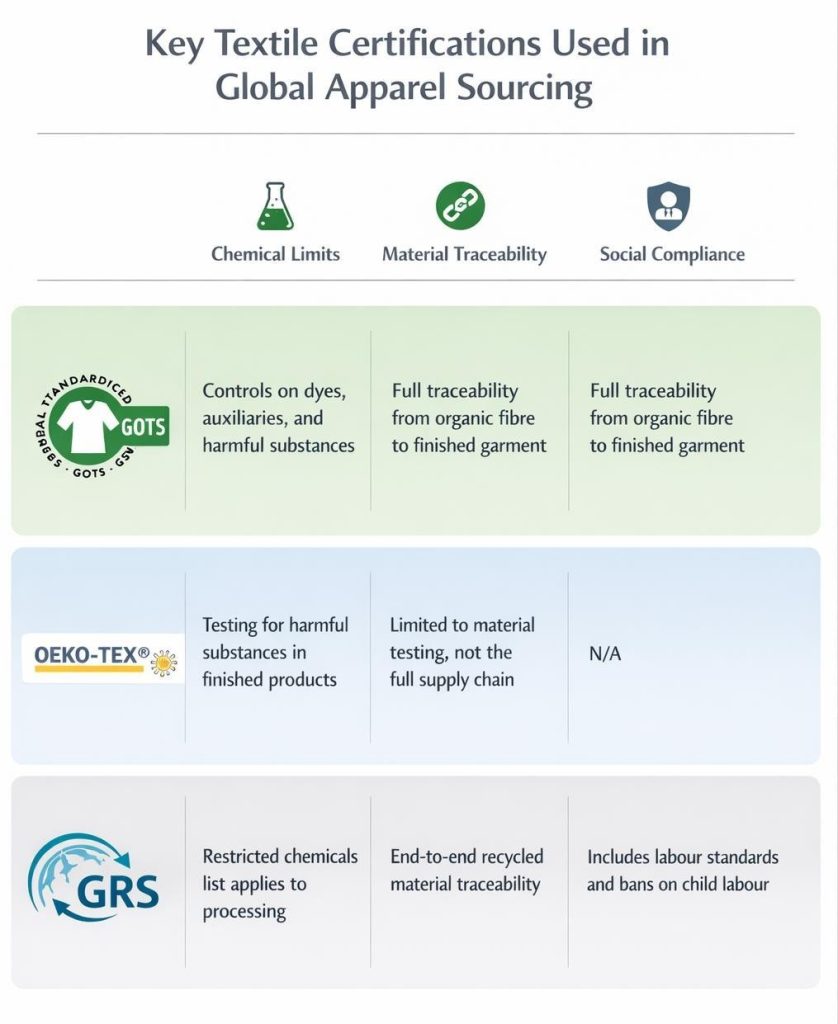
Equally important is validation at the material level. Certifications such as GOTS, OEKO-TEX and RCS confirm chemical safety, material traceability, and responsible processing practices. When paired with verified manufacturing processes, these frameworks enable buyers to maintain supply chain transparency from fibre selection through final shipment.
The US Consumer Product Safety Commission (CPSC) requires importers to maintain test records, trace materials, and demonstrate ongoing (CPSIA) compliance for children’s products.
Key components of a verified kidswear supply chain
Given these requirements, verified kidswear sourcing typically rests on four core validation pillars.
1. Certification & compliance validation in kidswear manufacturing
Certification serves distinct and complementary roles in kids’ manufacturing and children’s apparel sourcing. GOTS governs the integrity of organic textiles from fibre to finished garment. OEKO-TEX focuses on testing for harmful substances in materials. RCS and GRS validate recycled content claims, while SEDEX and SMETA address ethical trade and labour conditions.
India currently has the most GOTS-certified facilities globally, according to Fibre2Fashion and official textile ministry disclosures. This concentration allows buyers to scale certified sourcing without sacrificing compliance coverage.
2. Capability & quality assessment
Certifications alone do not ensure execution quality. Verified sourcing evaluates operational capability at the factory level and typically covers:
- Stitch density control
- GSM consistency
- Accuracy of patterns
- Seam strength
- Finishing quality
Export-ready manufacturers increasingly follow 4-tier inspection systems covering:
- Pre-production
- Inline
- Mid-line
- Final checks
This layered approach reduces rework, improves consistency, and aligns with buyer expectations for traceable quality control. In kidswear sourcing programs, these systems form a practical foundation for supply chain transparency during production.
3. Production monitoring & traceability
Visibility into production status has become a core sourcing requirement rather than a value-added feature. Verified sourcing models provide structured milestone tracking, early warning mechanisms, and order-level progress reporting.
India’s Kasturi Cotton Bharat initiative illustrates how traceability frameworks are becoming institutionalised, enabling batch-level tracking of cotton imports. When combined with production monitoring, such systems help buyers reduce last-minute disruptions, maintain schedule control, and strengthen supply chain transparency across multistage kidswear manufacturing processes.
4. Integrity & ethical practices of suppliers
Verified suppliers are assessed for ethical labour practices, workplace safety, and environmental controls. Global standards increasingly integrate social compliance with ecological criteria, particularly in children’s product categories.
By screening suppliers against these standards, buyers reduce exposure to reputational risk while ensuring alignment with public sustainability commitments. Ethical verification, when embedded into the sourcing workflow, supports long-term supplier relationships built on accountability rather than assumption.
India’s verified sourcing advantage in kidswear manufacturing
India’s apparel ecosystem offers a unique combination of scale and compliance readiness. High densities of certified factories, widespread adoption of organic and recycled materials, and mature export processes position the country as a reliable sourcing base for kidswear manufacturing.
Manufacturing clusters in Noida, Tiruppur, and Jaipur operate as integrated ecosystems spanning spinning, knitting, dyeing, stitching, and finishing. Supported by skilled labour and export experience, these clusters deliver consistent quality while maintaining supply chain transparency across production stages. According to PIB data, India’s textile and apparel exports reached USD 8.49 billion in the first half of FY2025-26, reflecting growing global confidence in its capabilities.
rivexa redefining trust through verified sourcing
rivexa, the digital export platform, enables global buyers to access more than 500+ vetted kidswear manufacturers in India. Buyers work with dedicated account managers to support sourcing decisions, supported by platform-enabled visibility and on-ground coordination to help keep orders aligned with plans.
Verified sourcing offers procurement teams a practical framework for managing risk, improving execution, and maintaining consistency across global programmes. Used by a growing base of global buyers and backed by 50+ successfully fulfilled orders, rivexa brings structure and confidence to modern social programs.
By connecting buyers with vetted compliance-verified manufacturers and enabling visibility at every stage, platforms like rivexa make verified sourcing scalable, reliable, and commercially viable. Get connected today! Speak with rivexa’s sourcing specialists to understand how verified sourcing can support your kidswear programmes.

Leave a Reply