
Procurement leaders across shipyard industries are increasingly looking for sourcing bases that can deliver multiple shipyard-related parts and components, such as propulsion or deck‑machinery orders on time, with compliant paperwork, and competitive landed costs. India now provides that edge. In September 2025, the government rolled out a ₹69,725 crore, four‑pillar push to make the Indian shipbuilding industry a globally dependable sourcing base for shipyard procurement teams, not just a domestic builder.
The advantages are buyer‑centric, including the ₹24,736 crore Shipbuilding Financial Assistance Scheme (SBFAS) from the Government of India to back contracts and offer ship‑breaking credit notes, a ₹25,000 crore Maritime Development Fund to lower the cost of capital, and a ₹19,989 crore Shipbuilding Development Scheme to build on capacity, risk cover, and cluster build‑out.
It all puts the industry on track with the concrete targets of the Maritime India Vision 2030. In addition, India’s 7,500-km coastline and Sagarmala 2.0 port upgrades reinforce the country’s shipbuilding in India, giving procurement teams reliable routing and cost efficiency needed for sourcing shipbuilding parts. You have a reliable base to curtail costs and de‑risk timelines, without compromising class approvals or quality.
Supplier base and capabilities in the Indian shipbuilding industry
When selecting suppliers for marine components, procurement heads should think in terms of clusters, not just individual manufacturers. India’s coastal belt gives you parallel suppliers capable of meeting identical specifications. So, you can keep builds moving even when one line hits capacity.
What these clusters actually produce
These clusters go beyond hull fabrication; they deliver a wide range of class-approved Indian shipbuilding components, such as:
- Marine-grade castings
- Hull plates
- Hydraulic power packs and manifolds
- Pressure-rated piping systems
- Cable trays
- Winches and windlasses
- Steering gear
- Complete outfitting kits
The practical gain for procurement teams? MSMEs within these clusters handle precision machining, heat treatment, shotblasting and coatings, NDT, and lab testing in the same area. That cuts long-haul dependencies, shortens ECO turnarounds, and keeps quality check ownership close to the shop floor.
Activate multi-yard sourcing options in India. Request a verified supplier shortlist from our sourcing specialists now.
Why logistics and timelines look better now
The port infrastructure in India is finally catching up with demand. Under Sagarmala 2.0, authorities cleared 800+ projects worth ₹5.5 lakh crore, for port upgrades, last-mile links, and inland waterways.
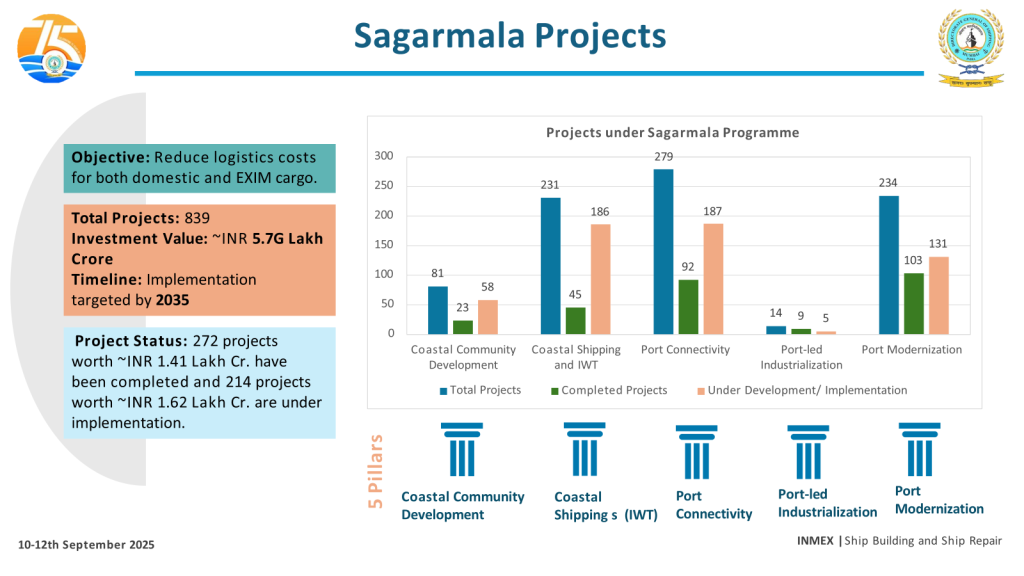
The mandate is simple: a significant push on inland cargo and more Indian ports inside the global top 100 in the context of shipbuilding in India. This directly supports procurement KPIs such as On-Time-In-Full (OTIF) and lead-time predictability.
When you need overflow options or parallel builds, you can plan against real yard capacity rather than estimates. State-wide tonnage bench strength, led by Gujarat and Kerala, gives you multiple routing paths for the same part families and specifications. According to the Directorate General of Shipping, India’s registered shipbuilding capacity reached 1.39 million DWT in 2025, led by Gujarat (936,000 DWT) in Kerala (253,000 DWT).
What this means for your next buy
- Match higher specification parts to clusters already running similar classed programs to accelerate technical validation cycles.
- Use improved port corridors and inland links to take variability out of timelines and protect handover dates.
- For phased orders or long programs, count on financing-enabled yards that can lock continuity, tooling, and stable ramp plans, supported by sectoral reforms in the Indian shipbuilding industry.
Therefore, you’re tapping into an ecosystem, not a single supplier.
India as a strategic choice for global buyers
When planning your next multi-yard framework agreement, align the strengths of shipbuilding in India with your sourcing priorities: cost, compliance, and delivery targets.
1. Competitiveness and skill advantage
You get more engineering per dollar. With labour productivity rising annually and composite fabrication costs lower than major East Asian yards, India delivers room in landed cost without cutting specifications or schedule.
2. Policy push and incentives
Financing and risk cover now work in your favour. Three key funds demonstrate capacity and continuity.
The Indian government’s Shipbuilding Financial Assistance Scheme provides financial support, ship-breaking credit notes, and steer domestic manufacturing through the National Shipbuilding Mission.
- The Shipbuilding Financial Assistance Scheme (SBFAS): ₹24,736 crore, including ₹4,001 crore in ship‑breaking credit notes
- The Maritime Development Fund (MDF): ₹25,000 crore and a ₹5,000 crore interest‑incentive window
- The Shipbuilding Development Scheme (SbDS): ₹19,989 crore for clusters and risk coverage
These incentives work in tandem with trade agreements like CEPA and ECTA, which simplify tariff treatment for marine exports.
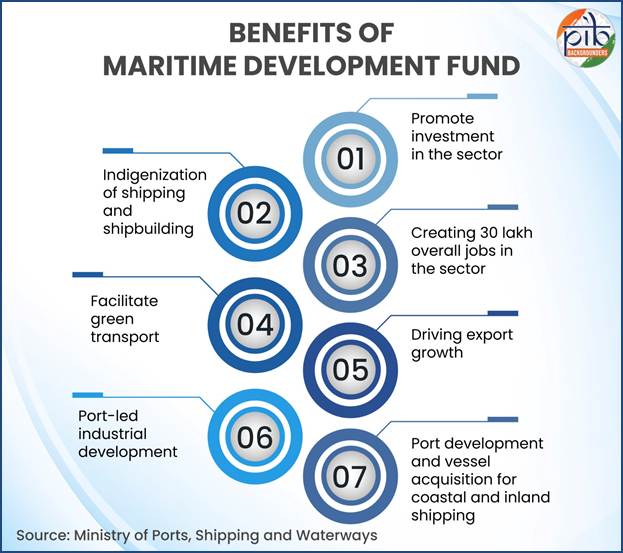
Image source: Ministry of Ports, Shipping and Waterways, via Press Information Bureau (PIB). “Benefits of Maritime Development Fund.
3. Compliance
Within shipbuilding in India, both yards and component manufacturers operate under ISO-aligned systems with class approvals from ABS, DNV, and BV. Maritime India Vision 2030 hard‑wires the sustainability track.
4. Trade connectivity
Bilateral corridors reduce friction on your logistics plan. The India-UAE CEPA is already smoothing tariffs and transit for marine equipment, while the India-UK FTA framework strengthens access for UK and EU‑adjacent programmes. Both of these prove useful when aligning multi‑yard schedules.
At the latest Maritime India Summit, MoUs reached ₹66,000 crore, with Indian exporters landing propulsion, hull, and deck systems orders into GCC yards.
Begin your procurement due diligence cycle! Get export-ready marine vendors and compliance documents through rivexa.
Key takeaways: advantages of the Indian shipbuilding industry
India’s shipbuilding evolution is not just about expanding capacity; it’s about building a predictable, class-compliant supply chain that aligns with procurement KPIs or production plans. If the goal is predictable timelines, clean compliance, and fewer last‑minute escalations, the signals are lining up in your favour.
- India’s policy stack is built for delivery, where financing, clusters, and port links work together to protect timelines.
- Coastal supplier clusters give you multiple options for the same specifications. So, one delay doesn’t stall the entire build.
- Port modernisation and inland trade corridors reduce friction during handoff, turning gate‑in uncertainty into predictable vessel connections.
- Class‑aligned manufacturing and ISO workflows in the Indian shipbuilding industry keep quality non‑negotiable while you scale order volumes.
- Dedicated maritime funds and infrastructure status stabilise capacity. This ensures that long programs don’t suffer stop‑start cycles.
Accelerate marine procurement with verified India supply partners
India has clear ambitions in place, targeting a 5% share of the global shipbuilding industry by 2030. If you’re trying to streamline supplies while curtailing landed costs, it’s time you consulted rivexa, your digital sourcing co-pilot.
Share your specifications with rivexa to access export-ready shipbuilding component manufacturers, submit drawings for custom parts, and an exclusive Time & Action module for easier production monitoring. In the process, sourcing teams can pilot fast and scale with confidence.
Upload your specifications to receive class-aligned supplier matches, RFx support, and Time & Action visibility engineered for shipyard timelines and multi-yard builds.

Leave a Reply