
Procurement leaders know that a single out-of-tolerance component can set of a chain reaction, disrupting production assemblies, delaying schedules, and affecting customer commitments across the entire system. The role of procurement has evolved. Decision makers are no longer just placing purchase orders; they are securing reliability across every tier of the supply chain. This is the moment to double down on building a resilient supply chain by embedding supply chain quality assurance into daily operations.
To strengthen control across assemblies and reduce cross-vendor friction, procurement teams can bundle allied items with core buys, such as valve bodies, flanges and couplings, and sealing solutions. This approach keeps specifications, coatings, and testing aligned under a unified plan.
When assemblies originate from a single manufacturing base, custom-fabricated skid frames or equipment bases can also be added to ensure proper alignment, vibration control, and cable routing early in the design phase.
India’s engineering exports rose by 2.13% in FY 2023-24 to reach USD 11.28 billion. This growth, coupled with stronger supplier compliance and digital traceability, has positioned India as a dependable sourcing hub for global buyers seeking scale and quality. Recent years have also seen a steady increase in engineering exports to WANA, Northeast Asia, CIS, and Oceania.
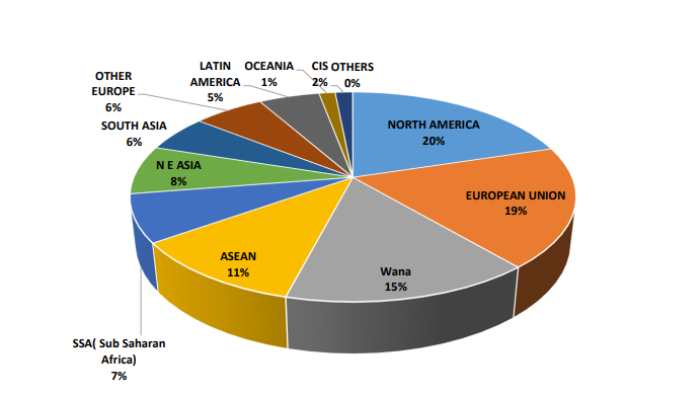
EEPC India, FY 2023–24. North America and the EU together accounted for nearly 40% of India’s engineering exports.
Procurement managers must make supplier risk assessment a non‑negotiable gate before price or lead time enters the conversation. Evaluate suppliers beyond the individual components they’re capable of supplying: verify the quality of hose assemblies and fittings, assess gasket performance under real operating conditions, and confirm the traceability of fasteners. This ensures that every part functions cohesively.
Identifying Component-Level Risks to Ensure a Resilient Supply Chain
Supply chain quality assurance involves identifying component-level risks to ensure resilience.
1. Material and dimensional risks
Small misses in materials and dimensions often create significant problems. Out-of-specification materials, wrong hardness, or a tiny dimensional drift on a sealing face can trigger leaks, vibration, or premature wear long before tests catch it.
Strengthen incoming inspection, maintain regular gauge calibration, and lock tolerances to what each process can reliably sustain. For rotating equipment, inspect valve body bore concentricity, flange flatness, and coupling alignment to protect pump shafts and seals.
This small step prevents costly teardown later. In hydraulic cylinder assemblies, verify rod hardness and the geometry of seal grooves, along with surface finish, to reduce premature leakage.
2. Environmental and fatigue risks
Corrosion, heat, and load cycles quietly eat away at parts. Fatigue cracks aren’t easily visible but simply show up as downtime. Specify coatings, finishes, and treatments that match real conditions, and conduct periodic NDT on high-stress features to validate performance.
Apply the same discipline to flanges and couplings with media‑appropriate gaskets, and check torque values using calibrated tools. This practice closes the loop between sealing design and real-world performance.
For sheet metal enclosures exposed to heat and moisture, align coating class and gasket IP rating during the RFQ stage to avoid late-stage design changes.
3. Assembly and alignment risks
Misalignment, poor fits, and worn fixtures turn good parts into bad assemblies. Add first-off checks for concentricity and runout, and refresh fixture maintenance, so that alignment becomes simpler and more accurate.
Include coupling fit verification on the base or skid frame, to ensure pump and motor alignment remains stable after tightening. Standardize hose routing and bend radii to prevent chafing and vibration transfer into the assembly.
4. Supplier disruption risks
Capacity constraints, logistics disruptions, or sudden regulatory changes can disrupt supply flow. Dual-qualify critical items, maintain an active secondary source, and integrate early-warning signals for logistics or regulatory risks.
Maintain secondary sources for valves, flanges, gaskets, and hose assemblies, as these directly affect installation continuity. For skid frames, pre‑approve alternates with shared hole patterns to enable rapid replacement without rework or redrawing.
5. Risks Related to Design and Specification Clarity
Ambiguous drawings and mismatched standards invite interpretation. Clearly define flange classes, gasket materials, coupling keyways, and surface finish parameters the RFQ or custom drawing.
Minor ambiguities at this stage can turn into leak paths and vibration issues later. When sheet metal enclosures are part of the scope, specify IP ratings, gland plate configurations, and earthing requirements in unambiguous terms.
Clear documentation is particularly critical when sourcing from overseas manufacturing hubs. Aligning standards and build tolerances with Indian suppliers early prevents ambiguity during the production cycle.
Mapping Risk to System Impact
Here’s what happens when small risks hit real operations.
1. Downtime and maintenance costs
A single bad bearing or misaligned seal can snowball into hours of lost production, extra shifts for recovery, and a maintenance backlog that pushes other jobs to next week. The real cost is the idle capacity you can’t earn back.
2. Warranty and After‑Sales Drag
Failures that leave the factory floor often escalate into warranty claims, diagnostic delays, and field-service costs. They extend diagnostics, tie up field teams, and inflate freight and credit notes. The longer the tail, the harder it is to keep margins where finance planned them.
3. Trust, brand, and reputation
Customers may overlook a single issue, but repeated faults quickly erode trust and lead to re-audits, dual-sourcing, or stricter service clauses. Repeated faults weaken a resilient supply chain, often triggering line audits, secondary sourcing, and stricter contract terms. Inside your plant, teams start padding schedules and reliability drops twice: on paper and on the floor.
How rivexa Helps Procurement Managers Build A Resilient Supply Chain
For procurement managers, reliability isn’t just a commitment; it’s a measurable practice visible on the shop floor. rivexa’s on‑ground teams audit quality processes, verify supplier processes, run in‑process and pre‑dispatch inspections for supply chain quality assurance. This ensures that India’s mandates and other quality requirements are fully implemented.
Vetted suppliers in our network are aligned on real milestones, with samples approved, holds cleared, and tests passed. Every lot comes with verified material certificates and compliance documents, digitally archived on a user-friendly dashboard. The results are measurable with fewer misses, faster recoveries, and a supply base that safeguards uptime throughout production cycles.
For global buyers, this means predictable timelines, transparent documentation, and sustained uptime — the core of a resilient sourcing partnership.
What Sets rivexa Apart?
Think of us as your digital co-pilot for all your India sourcing needs. Our marketplace model leverages digital marketing expertise to make access to international markets simple and secure. With transparent pricing, clear transaction tracking, and comprehensive support throughout the journey, we’re helping realize the vision of ‘Make in India for the World’ one successful partnership at a time.
Ready to map risk to reliability? Talk to our Industrial Goods sourcing experts here!

Leave a Reply