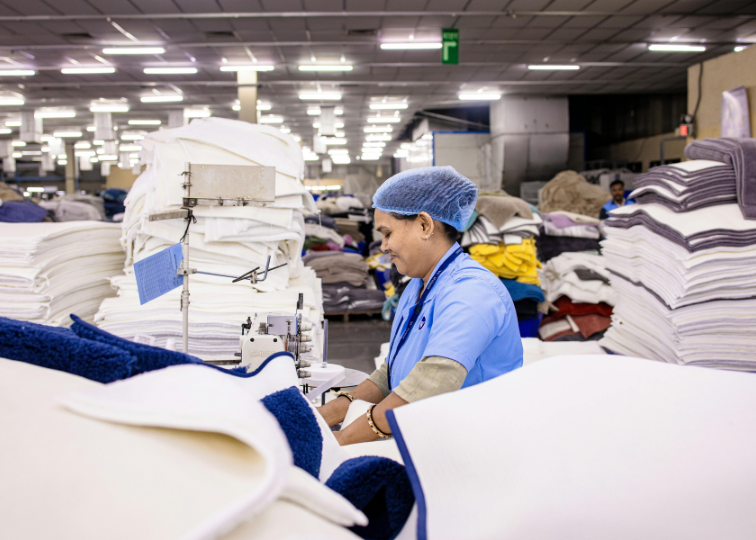
India is swiftly rising as a manufacturing giant and transforming global supply networks, as global trade reshuffles and recalibrates. Known for its textile heritage and cultural richness, India today offers more than tradition – it’s a reliable, modern and scalable global manufacturing hub offering comprehensive sourcing solutions for home textiles, apparel, and industrial components.
The current trade dynamics are keeping everyone on their toes, and India Inc stands out now, more than ever, as an increasing number of countries shift their focus to supply chain resilience. Offering better prices, quality, and a growing workforce, India’s manufacturing infrastructure is evolving at an impressive pace, all without the surprises that tend to come bundled with price spikes and policy shifts. In many respects, India’s apparel manufacturing rise isn’t just a well-timed coincidence; it’s tailor-made for the moment.
The Indian Apparel Manufacturing Sector
India is a big exporter of finished apparel, footwear, home textiles, and accessories. In FY 2023-24, clothing exports to the US, Canada, UK, Middle East and Europe had crossed the USD 16 billion mark (Fibre2Fashion).
Why Foreign Brands Are Turning to India for Apparel
- Skilled Labour & Craftsmanship: Indian apparel manufacturers have an edge over other countries since they are capable of mass-producing a variety of clothing. They also have skilled artisanal labour that specialises in weaving, embroidery, beadwork, and block printing.
- Vertical Integration: The textile sector in India is vertically integrated. The country has its ‘fibre-to-finished’ garment units that enhance control over quality, cost, and timing.
- Flexibility in MOQs: Indian exporters are versatile with minimum order quantities, starting from large bulk orders to small ones, catering to both small and large retail brands.
- Sustainability & Certifications: A growing number of clothing factories are now certified with GOTS and BCI (Better Cotton Initiative) standards and certification, and are adopting circular fashion principles.
Exporters in Tirupur, Salem, Chennai, and Karur are key players in India’s apparel manufacturing sector, producing everything from kids’ t-shirts, men’s and women’s inner garments, polos, sweatshirts, quilted and puffer jackets, joggers, vests, shorts, and a range of lowers catering to casual and formal wear sourcing requirements. Verified manufacturers can fulfil larger production volumes for:
- School uniforms
- Corporate and workwear
- Scrubs, lab coats, and other medical scrubs
- Accessories like belts, backpacks, wallets, handbags, etc.
- Women’s and men’s apparel
- Home textiles, including quilts, towels, bathrobes, and bedsheets
These are just some of the hubs that rivexa can provide you with easier access to. Several units within the Indian apparel manufacturing ecosystem even specialise in advanced fabric processing techniques like lava dyeing, indigo dyeing, acid wash, tie-dye, and garment dyeing.
India’s Home Textiles Production: A Quiet Yet Dominant Sector
While much of the attention tends to be on fashion, India is also a heavyweight in home textiles, exporting to the top markets in North America, Europe, Australia, and the Middle East. The category includes bed sheets and bathroom towels, as well as curtains, rugs, and decorative pieces of furniture.
India’s home textiles exports were valued at $5.7 billion in 2023, based on orders from brands offering value, innovation, and ethical sourcing, making it the second-largest home textile exporter after China (Textile Insights). Internal capabilities and ongoing trade tariff uncertainty bolster India’s home textiles production industry, setting it for growth. Experts project India’s home textile production growth to reach 8-10% in FY25 (Textile Insights)
Key Advantages for Home Textiles Sourcing from India:
- Design-Driven Manufacturing: India’s home textiles manufacturers at Karur, Salem, and Chennai collaborate with foreign buyers frequently. During these collaborations, they develop collections specific to local tastes, adding elements of international design trends, green materials, and artisanal finishes.
- Global Certifications: For safety, sustainability, and ethical production norms, most manufacturers adhere to OEKO-TEX®, followed by GOTS and SA8000.
- Cost Competitiveness: India is a natural choice for private-label household brands due to its low MOQ production and labour costs and high-quality workmanship.
Indian suppliers specialise in both making daily essentials and high-end collections. They offer fast sampling, private label facilities, and customised packaging solutions for different retail formats.
Expanding the Scope with Industrial Goods and Precision Components
India is now being viewed as the next leading global manufacturer for sourcing industrial components for aerospace, electronics, automotive, and heavy machinery industries. The country exported an impressive USD 109.3 billion worth of engineered goods in FY 2023-24 (April-March). This number increased to 6.74% in 2024-25 m valued at USD 116.67 (April-March). Components like castings, forgings, metal parts, and electrical hardware witnessed high demand (PIB).
Why India Works for Industrial Sourcing:
- Cost-Effective Precision: The high-quality materials available in India at cost-effective rates make it a preferred source for industrial sourcing.
- Global Partnerships: Indian suppliers are largely already plugged into global OEM supply chains, with JIT delivery, robust QC processes, and digital integration.
- Growing Number of Skilled Personnel: India produces about 1.5 million engineers each year, specialising in multiple fields (Business Standard)
Pune, Coimbatore, Rajkot, and Ahmedabad clusters are well known for their precision engineering capabilities. They are increasingly in accordance with Industry 4.0 standards.
Why Global Brands Are Choosing India
Since the world is trying to broaden its sourcing base, the global manufacturing hub India has all the right features. The following are the reasons it’s the most preferred choice among B2B buyers:
Scale and Specialisation
Global manufacturing hubs in India offer massive production capabilities along with special, value-added manufacturing for differentiated needs.
Leadership in Sustainability
In India, textile industries complement ESG strategies with the use of solar energy, zero-discharge water technologies, green colourants, and biodegradable packaging.
Competitive Pricing
Global firms consider India a global manufacturing hub as one of the most cost-effective destinations for sourcing materials. The country continues to cater to its needs even with rising global inflation without deteriorating in quality.
Government Incentives
The Indian government has taken effective initiatives like the PLI (Production Linked Incentives) to attract international investment. With reduced rates of corporate tax and simplified customs clearance, the country attracts international investment.
Improved Infrastructure
The country has streamlined exports through electronic customs clearance, new ports, and augmented logistics corridors.
Looking Ahead: A Strategic Manufacturing Partner
Global manufacturing hub India has emerged as a hub for outsourcing industrial materials at low cost. Global brands must seize this opportunity to tap into Indian suppliers that offer innovation, competitive pricing, and ethical manufacturing techniques.
You may be a fashion retailer looking for reliable suppliers for apparel or a home brand seeking textile partners. In any of these situations, India continues to be a top choice to fulfil your requirements.
Contact rivexa to connect with leading Indian home textiles production and Indian apparel manufacturing suppliers. We help global brands find verified textile suppliers at competitive prices.

Leave a Reply