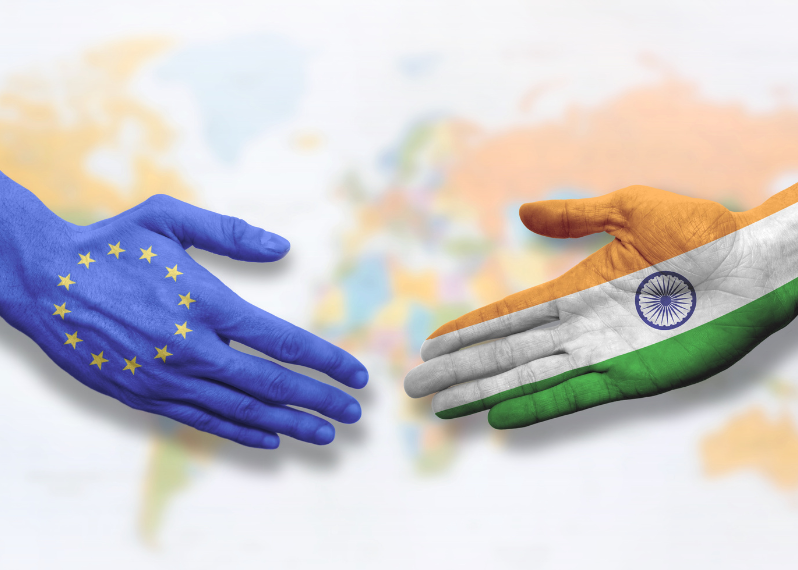
India and the European Union have concluded negotiations on a long-awaited free trade agreement, marking a significant milestone in bilateral economic relations after nearly two decades of talks.
The free trade agreement was signed during the India-EU summit in New Delhi, attended by Prime Minister Narendra Modi, European Commission President Ursula von der Leyen, and European Council President Antonio Costa.
Describing the pact as ‘the mother of all deals’, Prime Minister Modi said the deal would support multiple export-oriented sectors, including textiles, gems and jewellery, leather, and footwear. European Commission officials underscored the agreement’s significance, positioning it as a step toward closer economic cooperation amid global trade volatility.
Trade significance market reach
Tariffs on over 96.6% of EU goods exports to India will be eliminated or reduced. Over 99% of Indian exports in value to Europe will now enter duty-free. The India-EU free trade agreement links two major economic blocs that together represent nearly a quarter of global GDP and roughly one-third of international trade.
According to European Commission data, goods trade between India and the EU exceeded €120 billion in 2024, making the bloc India’s largest trading partner. India currently ranks as the EU’s ninth-largest trading partner, accounting for about 2.4% of the bloc’s total goods trade.
Market access and tariff reductions
- EU tariffs on Indian footwear are expected to drop from 17% to zero, making Indian footwear more price-competitive for European buyers.
- Indian apparel exports to the EU are set to see tariffs fall from 12% to zero, directly improving landed costs for European importers.
- Textiles from India will move from a 12% tariff to zero duty in the EU, strengthening India’s position in textile sourcing.
- EU tariffs on Indian base metals are projected to reduce from 10% to zero, lowering input costs for European manufacturers.
- Indian tariffs on European machinery and electrical equipment will drop from up to 44% to zero.
- European aircraft and spacecraft will see Indian tariffs fall from up to 11% to zero.
- Motor vehicles from Europe will face reduced Indian tariffs, down to 10% under quotas.
- Iron and steel from Europe will experience Indian tariffs dropping from up to 22%.
Negotiation history and next steps
India and the EU first launched FTA negotiations in 2007, but talks were suspended in 2013 due to differences over tariffs, market access, intellectual property, and sustainability standards. Negotiations resumed in June 2022 and have now concluded after sustained engagement.
If formally signed and provisionally applied, the agreement could begin delivering trade benefits within months. Full ratification, which requires approval by EU member states and the European Parliament, is expected to take 12 to 18 months, potentially bringing the agreement fully into force by late 2027 or early 2028.

Leave a Reply