Key Takeaways
3-axis is perfect for basic, high-volume products like brackets or housings when time and pricing are crucial.
5-axis suits complex, high-precision components perfect for low volume custom CNC machining, such as impellers or curved molds, where setup costs are justified by accuracy and finish.
India’s online custom CNC machining services offer a smart balance of quality, cost, and lead time, especially when combined with a smart sourcing platform that aligns each part with the most suitable manufacturing process.
Sourcing custom low volume custom CNC machining parts from overseas? Then you already know—even one wrong choice can throw off your schedule, inflate costs, or create quality issues down the line.
This is particularly true in the case of CNC machining. While the difference between 3-axis and 5-axis might sound technical, it plays a major role in the precision of your output and the overall cost you incur.
Many buyers default to 3-axis because it’s familiar, quick, efficient, and gets the job done—until your part gets a little too complex. Then things start to slow down, more setups, and more chances for errors.
That’s when 5-axis becomes tempting. One setup, more angles, better finish. But it also comes with a bigger price tag and longer programming times.
Making the Right Call
That’s where a lot of global buyers get stuck—leading to mismatched quotes, inconsistent parts, or late deliveries.
And if you’re managing an international supply chain, here’s the good news: a growing base of verified custom CNC machining manufacturers in India are making sourcing easier.
Suppliers are stepping up—not just in cost savings, but in capability. rivexa connects you to pre-vetted custom CNC machining manufacturers in India, across states like Punjab, Maharashtra, etc. Our precision shops located here are producing parts that meet international tolerances and doing it with impressive consistency.
This guide is ideal for buyers looking into low volume custom CNC machining for prototypes or short runs. We’re also here to help you figure out what works best for the parts you need to source or custom manufacture. Whether your priority is precision or price, we’ll help you source smarter.
Subtractive Manufacturing, Explained Better
CNC machining is the backbone of subtractive manufacturing – where precision tools cut, drill, or mill material aways from a solid block to shape the final part. Whether it’s plastic, aluminum, or steel, the process transforms digital CAD data into physical components with the right tolerance limit and repeatability.
What Makes CNC So Reliable
Digital design files (CAD) direct the motion of every tool, precisely modeling the product down to the finest detail. It is a great option for sectors where even small mistakes are unacceptable due to its precision, like:
- Aerospace
- Automotive
- Medical devices
- Consumer electronics
The strength of CNC machining lies in drawing-based accuracy, ensuring that each part meets exact dimensions, tolerances, and repeatability standards.
Having set the context, let’s explore 3‑axis machining next.
3‑Axis CNC Machining Explained
In this method, the cutting tool moves along three straight paths:
- X (side to side),
- Y (back and forth), and
- Z (up and down).
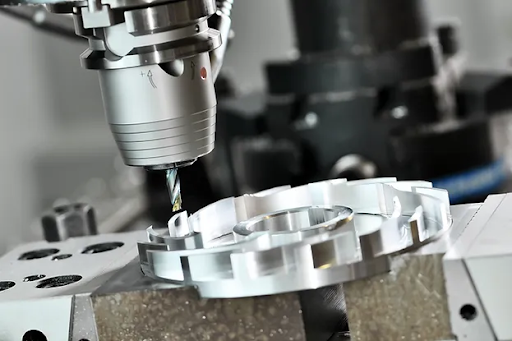
The workpiece stays in place while the tool shapes it from above. This setup works well for:
- Flat parts with simple geometry.
- No need for cutting under surfaces or complex angles.
Also, common components include:
- Brackets
- Flat panels and covers
- Mounting plates
- Valve housings
It remains a popular option for good reason, especially in online custom CNC machining services aimed at basic part runs. Here’s why:
1. Affordable:
Helps cut down on running costs and limits the need for heavy infrastructure.
2. Fast Turnaround:
Simple programming and quick setup get production moving faster.
3. High volume ready:
Ideal for repetitive, straightforward parts.
However, how does this play out in real-world sourcing? Here we see:
Indian workshops under rivexa’s sourcing network frequently handle large-volume 3-axis jobs.
For example, a supplier in Pune produces a certain number of panels for European clients with just a few days’ lead time and with excellent consistency. This is one of the many examples of custom CNC machining manufacturers in India meeting global needs.
Let’s now explore the advanced counterpart: 5‑axis machining.
5‑Axis CNC Machining Explained
It adds two rotary axes—usually labeled A and B—to the standard X, Y, and Z.
With those extra axes, the tool moves around the part from various angles. That lets you shape intricate designs that 3-axis machines can’t reach.
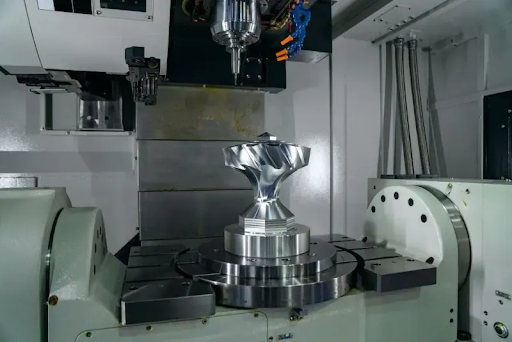
Why does that matter? This flexibility lets you finish complex features in a single setup. You save time and reduce setup errors by avoiding multiple repositioning attempts.
But the benefits go even further, where 5-Axis CNC shines:
1. Single Setup:
Machine even the most intricate parts—like aerospace blades or mold cores—in one continuous operation. No need to stop or reposition the workpiece.
2. Tight Tolerances:
Hit specs of around ±0.001 in (≈0.005 mm). That’s more precise than typical 3-axis results.
3. Superior Surface Finish:
Maintain optimal tool angles during continuous motion. That cuts tool marks and smooths out surfaces.
4. Reduced Tool Wear:
Better cutting angles, lower force and heat on the tool. That minimizes wear and extends tool life.
5-axis machines excel with parts featuring complex shapes, tight clearances, or curved surfaces. They deliver high precision and reliable consistency, a benchmark for advanced online custom CNC machining services, often in a single setup, without compromises.
You’ll often find it used for:
- Aerospace components
- Medical implants
- Complex molds and impellers
- Undercut features and sculpted surfaces
These are the types of jobs where 5-axis truly justifies its higher setup cost—saving time, boosting quality, and ensuring reliable outcomes in a single machining cycle.
However, initial cost and programming expertise are higher. Before deciding, here’s a side‑by‑side table comparison.
3‑Axis vs. 5‑Axis: Quick Comparison
This table shows that 3‑axis offers quick, affordable results for planar work, whereas 5‑axis is preferred for low volume custom CNC machining due to its one-setup efficiency.
| Feature | 3-Axis | 5-Axis |
| Axes of Movement | X, Y, Z | X, Y, Z + A, B (Rotary) |
| Setup Time | Multiple Setups | Single Setups |
| Part Complexity | Simple | Complex |
| Cost | Loewr | Higher |
| Ideal For | Brackets, Panels | Turbine Blades, Molds |
Final Cut: Your Next Move in CNC Sourcing
Making the right choice between 3-axis and 5-axis doesn’t have to be overwhelming. Here’s how rivexa simplifies the process of choosing the right custom CNC machining manufacturers in India:
1. Drawing-Based Sourcing
Just upload your CAD drawing. rivexa’s platform analyses the geometry and complexity, then matches your design to the most suitable CNC shop—whether 3-axis or 5-axis. We only match you with verified custom CNC machining manufacturers in India.
2. Full Quality Assurance
All suppliers deliver QC reports with dimensional traceability, often using calibrated CMMs. You can verify every critical spec before shipment.
3. Access to India’s CNC Clusters
rivexa connects you to pre-vetted suppliers across Pune, and Maharashtra—regions known for specialized capabilities in CNC machining. These regions are now home to top-rated online custom CNC machining services, trusted by global buyers.
You get the benefit of local expertise with global standards. Thus, you avoid mismatched quotes and inconsistent quality while leveraging India’s precision clusters.
Still wondering which method is best for parts you plan on sourcing? Let’s break it down based on what matters most to you—cost vs precision.
Precision or Price? What’s Important
The best machining technique depends on what your item requires, whether you are looking to satisfy specific requirements or maintain prices reasonable. Here’s how to decide when to choose 3‑Axis:
- Your part has simple geometry
- Tolerances are around ±0.002 in
- You’re running large volumes
- Budget is a priority
For example, A valve housing used in low-pressure applications with standard fits can be machined on a 3-axis machine with minimal setup time and high repeatability.
On the other hand, when do you need to step up to 5‑axis?
- Your part requires complex contours or undercuts
- Tolerances are tighter than ±0.001 in
- Parts must be machined in one go to maintain integrity, especially in low volume custom CNC machining scenarios
- You need an aerospace-grade surface finish
Example: An impeller with intricate blades for aerospace cooling systems demands high-precision 5-axis machining offers advantages in low volume custom CNC machining when building complex profiles, such as maintaining balance, avoiding tools marks, etc.
Not sure how to decide at a glance? Here’s a quick decision matrix to guide your selection:
| Factor | When 3‑Axis is Best | When 5‑Axis is Best |
| Tolerance | ±0.002 in acceptable | ≤ ±0.001 in required |
| Volume | High-volume batches | Moderate runs where complexity dominates |
| Geometry Complexity | Planar, simple profiles | Curved, contoured, undercut shapes |
| Lead Time | Fast, days-long TAT | Still fast, but setup/programming intensive |
| Budget | Low capital/part cost | Higher cost per part, but reduced error risk |
This framework helps you choose the process aligned with the part specifications.
rivexa as your CNC Co-Pilot
Both technologies have their place – your part’s requirements dictate the process. Whether it’s for high runs or low volume custom CNC machining, rivexa has the right supplier for you.
3-axis makes sense if performance and cost are your top concerns and geometry is straightforward. Yet when precision, surface finish, and fewer setups matter most, 5‑axis is the strategic choice.
Navigating these options isn’t easy. That’s why rivexa simplifies the decision: by pre‑vetting suppliers, analyzing your CAD data, and connecting you with India’s ideal CNC partner, streamlining your custom part sourcing journey.
Ready to optimize your CNC sourcing? Upload your CAD drawings now and get matched with the right-fit online custom CNC machining services in India.

Leave a Reply