Key Takeaways
The wrong impeller type or material can drain your budget through higher maintenance, more energy consumption, and unexpected downtime.
Each impeller is built for very different operating conditions. Therefore, aligning impeller specs with the fluid profile and pressure requirements is critical.
With rivexa, global buyers can access a network of certified stainless steel impeller pump manufacturers for OEMs offering MOC-accurate sourcing, QC-backed documentation, seamless logistics for lower sourcing risk, and faster turnaround.
Impellers selection varies significantly in quality and performance. When you’re sourcing at scale, choosing the right impeller is a strategic decision. For global buyers working with custom impeller pump manufacturers in India, the choice between open and closed impellers extends beyond technical specification – it directly impacts both costs and overall operational performance.
Choose incorrectly, and you risk facing:
- Excessive energy costs
- Repeated breakdowns or failures
- Pump incompatibilities that reduce operational efficiency
Choose correctly, and you benefit from:
- Smoother system operation
- Reduced maintenance requirements
- Measurable returns on every unit sourced
How do you choose the right impeller when sourcing from India’s extensive supplier network, where quality standards can be inconsistent? This guide will help you identify reliable impeller pump manufacturers in India while avoiding common sourcing pitfalls.
Breakdown of Impeller Types: What They Do & When to Use Them
Each impeller type is designed for a purpose. Think of them as different tools in your engineering toolbox, each one for specific fluid behaviors and pressure conditions.
| Impeller Type | Best For | Efficiency | Maintenance | Max Size (mm) | Max Weight (Kg) |
|---|---|---|---|---|---|
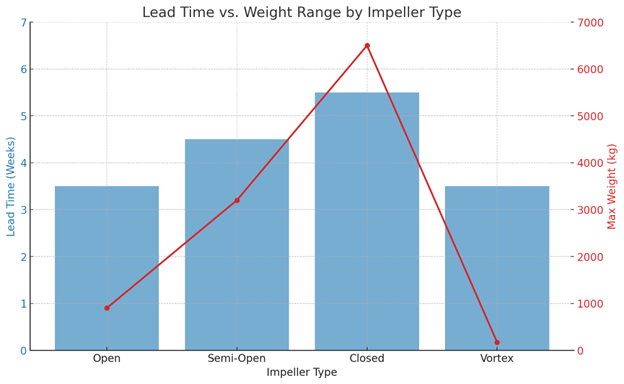
| Open | HVAC, clean water | ⭐⭐ | ⭐⭐⭐⭐ | 1800 | 900 |
| Semi-Open | Wastewater, light slurries | ⭐⭐⭐ | ⭐⭐⭐ | 1400 | 3200 |
| Closed | Chemicals, high-pressure systems | ⭐⭐⭐⭐ | ⭐⭐ | 2200 | 6500 |
| Vortex | Slurry, fibrous solids | ⭐ | ⭐⭐⭐⭐ | 1000 | 170 |
Open Impellers
Design:
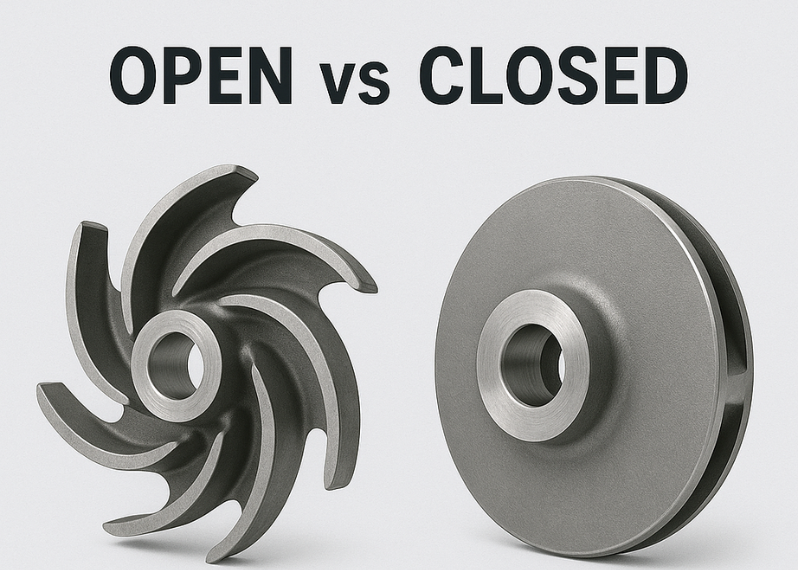
Design involves a simple structure with vanes attached to central hubs. They do not have shrouds or side plates.
Suitability:
Ideally suited for use in handling cleaner, low-viscosity fluids like HVAC systems, cooling water, and circulation pumps, where fluids are consistently present and maintenance access is easier. Fit for budget-conscious systems dealing with predictable, clean liquids.
| Pros | Cons |
| Economical to produce and replace | Lower efficiency under high-pressure conditions |
| Easy to inspect and clean | Not suitable for abrasive or corrosive applications |
| Can handle small particles without clogging | Performance dips if fluid conditions vary |
Semi-Open Impellers
Design:
Partially enclosed, one side shrouded, and the other is open.
Suitability:
Handling fluids with moderate solids like pulp, wastewater, or mildly abrasive slurries. Fit for paper, textile, or wastewater industries or any process where fluid consistency varies.
| Pros | Cons |
| Good balance between efficiency and maintenance ease | May need regular clearance adjustments |
| More forgiving with particle-laden fluids | Not as efficient as closed impellers under high head pressure |
| Fewer wear issues compared to fully enclosed models |
Closed Impellers
Design:
Vanes are completely enclosed between two shrouds built for performance under pressure.
Suitability:
Ideal for chemical processing facilities, oil refineries, and pharmaceutical manufacturing plants. Fit for precision-driven systems that prioritize uptime, flow control, and long-term efficiency.
| Pros | Cons |
| Delivers maximum hydraulic efficiency | Prone to clogging with solids |
| Reduces energy loss from slippage | Higher cost to maintain and clean |
| Durable when handling clean, controlled fluids | Overexpenditure if the job doesn’t demand that level of performance |
Vortex Impellers
Design:
The impeller is recessed, creating a swirling vortex that moves fluid indirectly and is ideal for dirty fluids.
Suitability:
Slurries, sludge, fibrous waste, abrasive media or any application where clogging is a constant threat. Fit for municipal wastewater, mining, pulp & paper, or any high-solid content systems
| Pros | Cons |
| Practically clog-free | Lower hydraulic efficiency compared to traditional designs |
| Withstands wear even with harsh or abrasive particles | May need more space (larger housings) |
| Long lifespan with minimal intervention |
How to Source from Impeller Pump Manufacturers: Key Specs
Technical specifications and material compatibility should guide your RFQs when sourcing impellers from custom pump manufacturers in India.
1. Size and Weight Ranges
rivexa’s suppliers offer precision-cast impellers in a wide spectrum:
- Closed Impeller: Up to 2200 mm diameter, 6500 kg
- Open Impeller: From 50 mm to 1800 mm, 0.5 kg to 900 kg
- Semi-Open Impeller: Up to 1400 mm, 3200 kg
- Vortex Impeller: Up to 1000 mm, 170 kg
2. Material of Construction (MOC)
MOC isn’t just about corrosion resistance; it also impacts weight and lifespan. Common options offered by stainless steel impeller pump manufacturers for OEMs include:
- Cast Iron: For clean water and HVAC
- Stainless Steel (SS 316): For chemical, pharmaceutical, and food-grade pumps
- Bronze/Brass: For marine and seawater
- Aluminum: For lightweight or mobile units
- Carbon Steel: For non-corrosive industrial fluids
With rivexa, you can source impellers precisely matched to both MOC and dimensional specs. Zero guesswork and minimum downtime during installation.
Key Decision Factors: Lead Time, Volume, Replacement Cycles
Beyond specs, global procurement teams must consider how supply chain variables affect plant performance before placing their orders with custom impeller manufacturers in India.
1. Lead Time
Delays in impeller sourcing can halt production or delay scheduled maintenance. Indian suppliers via rivexa typically offer:
- Standard Production: 4–6 weeks
- Express/Urgent: 2–3 weeks for stocked designs or repeat orders
2. Volume & Repeatability
Sourcing from manufacturers who can handle batch volumes consistently is crucial for enterprise operations. rivexa works with partners who support both one-off engineering builds and bulk OEM programs.
3. Replacement Planning
Understanding wear cycles by impeller type allows better MRO forecasting.
- Open/Semi-Open: Easier to replace, shorter wear cycles.
- Closed: Longest life but highest replacement complexity.
- Vortex: Low failure rate but often requires specialized casing compatibility.
By matching wear tolerance to expected fluid stress and plant conditions, procurement heads can better align CAPEX with O&M budgets.
| Application | Open | Semi-Open | Closed | Vortex |
| HVAC Systems | ✅ | ✅ | ❌ | ❌ |
| Chemical Plants | ❌ | ✅ | ✅ | ❌ |
| Wastewater Treatment | ✅ | ✅ | ❌ | ✅ |
| Food & Pharma | ❌ | ✅ | ✅ | ❌ |
| Marine/Seawater | ❌ | ✅ | ✅ | ❌ |
| Slurry/Solids | ❌ | ✅ | ❌ | ✅ |
rivexa Simplifying Impeller Pump Manufacturers Selection & Sourcing
With international sourcing, technical alignment is half the battle. But rivexa makes impeller procurement frictionless:
1. Drawing-Based Sourcing
Already have an OEM drawing or CAD spec? rivexa’s suppliers can reverse-engineer, adapt, or replicate impellers to exact tolerances—across MOC, vane angles, shaft fitment, and more.
2. Built-in QC and Documentation
You’ll receive:
- MOC compliance certificates
- Third-party inspection reports
- Dimensional inspection logs
- Managed payment system
- Time and Action Module for easier monitoring
3. Value-Added Logistics Support
From quotes to customs, rivexa offers value-added services to help you easily manage:
- Freight optimization
- Packaging for international transit
Communication with our manufacturers is centralized – no chasing down vendors or translators across multiple time zones.
Find Impeller Pump Manufacturers in India on rivexa
If functionality meets sourcing efficiency, long-term value compounds. Choosing the right custom impeller pump manufacturers in India reduces failures and downtime.
By weighing trade-offs between different impeller designs and materials, procurement heads can balance performance, budget, uptime, and serviceability.
If you’re unsure where to start, rivexa shows you how to source impeller pump manufacturers in India. As a registered buyer, you can search and compare suppliers based on their capabilities, business history, and ratings.
We verify all suppliers before onboarding them onto our marketplace. This includes taking a closer look at compliance documents, certifications, quality processes and more.
Suppliers are then rated on a scale of 1 to 5 across all parameters. During live orders, we conduct periodic factory visits to provide on-site support and ensure adherence to quality standards and delivery timelines.
The result: accuracy, accountability, and application-ready solutions from India’s best engineering manufacturers. Don’t just compare specifications, reach out to our industrial goods specialists here.

Leave a Reply