India became the world’s second-largest steel producer, surpassing Japan in 2019, according to the World Steel Association. Steel remains central to the Indian economy, supporting infrastructure development, energy generation, and industrial manufacturing across sectors.
When it comes to sourcing, India’s steel industry represents more than output volume. It reflects production depth, improving material consistency, and an expert orientation shaped by long-term investment. This is the foundation that supports India’s rise in electronics and advanced manufacturing, where dependable steel inputs remain critical.
Legacy producers such as Tata Steel, founded in Jamshedpur in 1907 by Jamshedji Nusserwanji Tata, continue to shape this industrial base while investing in modern production methods that align with global buyer expectations.
This article delves deeper into the strengths of India’s steel sector and outlines how international buyers can leverage these strengths to gain sourcing advantages through rivexa’s India-focused model.
India’s steel industry: the backbone of technological advancement
The steel industry is the engine and pioneer of progress. Modern technologies such as electric arc furnace, EAF, and continuous casting technology are widely used in the country’s steel mills.
Electric arc furnaces:
These innovations have transformed manufacturing, ensuring consistent quality and reducing energy use. For example, one of India’s top steelmakers, Tata Steel, has significantly expanded its production capacity at its Jamshedpur facility by integrating new, cutting-edge blast furnace technology.
Continuous casting:
By reducing waste and enhancing product quality, this technique has optimised the steel production process. Another significant operator, JSW Steel, applies this method extensively at its Vijayanagar factory, which has improved productivity and raised the quality of its steel.
Automation:
Adding automation to the steel industry has increased output and improved quality assurance. AI is being used effectively in several fields, including process optimisation, quality prediction, and predictive maintenance.
Moreover, elevating the Industrial Standard through Superior Production, India is well known for manufacturing steel of the highest calibre that satisfies global requirements. The prioritisation of quality control and strict adherence to quality standards guarantees the high demand for Indian steel in the international market.
1. Strict quality assurance:
At every level of manufacturing, Indian steel makers adhere to strict quality control protocols. This guarantees that the steel produced is of the highest calibre, flawless, and meets the requirements set by various industries.
2. Research and development:
By consistently allocating resources towards this area, Indian steel firms have been able to innovate and manufacture steel. The highest calibre and new steel grades meet the changing requirements of many industries as a result of this emphasis.
Ministry of Steel has sought R&D project proposals in joint collaborative mode from reputed academic institutions, research laboratories and steel companies for pursuing R&D projects for development of new alternate processes and technologies to address the burning issues faced by the iron and steel sector such as green steel production, H2 – based production, CCUS, waste utilisation, resource efficiency, for providing financial assistance under the R&D scheme.
3. Development towards zero-emission steel:
The iron and steel sector represents around 7 per cent of global energy-related CO2 emissions. According to the IEA, early efforts have begun with the Confederation of Indian Industry (CII) through its GreenPro labelling system, but this covers a broader range of factors beyond emissions, including water and land use. GreenPro covers a range of steel products, including automotive steel (from 3 companies), steel pipes (from 4 companies), and steel rebars (from 24 companies).
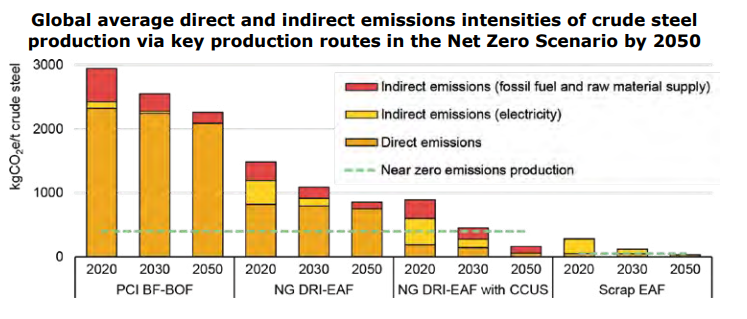
Source: Ministry of Steel
India’s expanding export industry:
The steel industry has seen a significant rise in exports, strengthening its position as a global leader in steel production. India’s finished steel exports were 7.5 million metric tons during FY 2023-2024, up 11.5 per cent from the previous year.
Crude steel output stood at 143.6 million metric tons, up 12.9 per cent from a year earlier, data showed. The sector experienced annual export growth of 10%-15%, fueled by improved manufacturing capacity and rising global demand.
India accounted for about 4.5% of the world’s steel exports in 2023. As production capacity and demand rise, we anticipate more growth. The National Steel Policy 2017 aims to achieve 300 million tonnes of steel-making capacity by 2030.
Cost competitiveness of Indian steel:
One of the main advantages of India’s steel industry is its competitive prices. Abundant raw materials, low energy costs and advanced production processes make Indian steel very profitable.
Abundant raw materials:
India is rich in iron ore and coal, which are the primary raw materials for steel production. This level of product reduces delivery reliability and helps keep production costs low.
Economies of scale:
Extensive manufacturing facilities allow Indian manufacturers to achieve economies of scale, further reducing costs. Companies such as Tata Steel and JSW Steel operate some of the largest steel mills in the world, allowing them to produce steel at competitive prices.
rivexa’s and mjunction’s unique value-based offerings.
rivexa, b2b marketplace, stands out as a key player in the Indian steel industry. We offer unique products and services that cater to the diverse needs of international buyers.
rivexa’s key strengths:
Customised drawing-based manufacturing:
rivexa offers tailor-made steel solutions that meet the specific custom product requirements of the steel industry. rivexa provides customised steel products that meet its clients’ exact specifications.
Platform of excellence:
rivexa has leveraged the latest technological advancements to ensure efficiency, productivity, and transparency in its cutting-edge Time & Work platform. What distinguishes the company from its rivals is its emphasis on innovation and ongoing progress.
Maintain a robust global supply network:
rivexa guarantees on-time delivery to customers worldwide through its robust supply chain. The company’s shipping and handling capacities make serving clients worldwide simple.
rivexa employs ecologically friendly methods in its activities as part of its commitment to sustainability.
rivexa aligns its sustainable approach with the global movement towards green design, encompassing energy-efficient architecture and conscientious waste management.
Knowledge and experience:
With a team of professionals and more than 23 years of experience in the steel industry, rivexa offers steelmakers a unique skill set.
The company has a deep understanding of the steel industry and business environment. It allows it to provide valuable insights and solutions to its customers.
Conclusion:
India’s steel industry is a force to be reckoned with on the global stage. It showcases advanced technology, high-quality production, cost competitiveness, and sustainable practices.
rivexa exemplifies the strengths of the Indian steel industry with its unique offerings and capabilities. By partnering with rivexa, international buyers can leverage these strengths to achieve their business goals and benefit from high-quality, cost-effective, and sustainable steel solutions.

Leave a Reply